
Mr Toogood's Physics
A Level Physics notes to support my lessons at LCS
A Level Physics notes to support my lessons at LCS
You are only expected to know how to use the four SUVAT equations, and although you do not need to know how to derive them first principles (i.e. learn to write them out from very basic assumptions to show where they come from) it is useful to see how they come about to help understand them fully.
The term first principles means the most basic assumptions one can make about a physical system. This may be a physical law such as Newton’s laws of motion or from definitions such as that for velocity and acceleration
Equation 1
This is the simplest to derive, and comes from understanding the definition of acceleration,
Δv can be stated as (v−u) or the final velocity of an object minus its initial velocity. So:
Both sides can now be multiplied by t:
To make this equal v, u needs to be added to both sides, which results in the final equation:
Equation 2
If an object is travelling from point a to b its velocity may vary. Its average velocity between the two points can be calculated by adding the instantaneous velocity at a (u) to the instantaneous velocity at b (v) and dividing by 2:
The velocity equation can be re-arranged in terms of s, so that s=vt which leads to:
Equation 3
We know that from a velocity-time graph the displacement is represented by the area underneath the line.
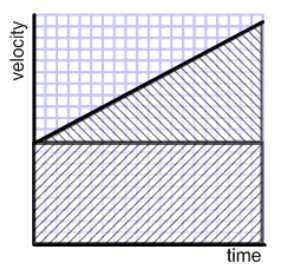
The area under the bottom section of the graph can be calculated by multiplying the initial velocity, u, by the time, t:
The area under the top section of the graph is found by subtracting the initial velocity, u, from the final velocity, v, and multiplying that by the time:
So a statement for the total displacement could be $s=ut+\frac{1}{2}\left ( v-u \right )t$
However the term (v−u) also appears in the equation for acceleration, so can be replaced by at which leads to:
Equation 4
This is the hardest to derive, but often the most useful of the four equations. Starting with s=vt we can substitute from equation 2 and the equation for acceleration to give:
This can be rearranged as:
The brackets can now be multiplied out:
Which finally gives: