
3.4.1.2 Moments
Moment of a force about a point.
Moment defined as: force × perpendicular distance from the point to the line of action of the force.
Couple as a pair of equal and opposite coplanar forces.
Moment of couple defined as: force × perpendicular distance between the lines of action of the forces.
Principle of moments.
Centre of mass.
Knowledge that the position of the centre of mass of uniform regular solid is at its centre.
Moments
Forces can have translational effects, i.e. pushing a block across a tabletop or they can have rotational effects. The turning effect of a force about an axis is called its moment. It can be thought of as the leverage of the force. It is increased as either the magnitude of the force is increased or its distance from the point of rotation.
A moment is defined as:
Moment = magnitude of the force × perpendicular distance of the line of action of the force from the axis of rotation
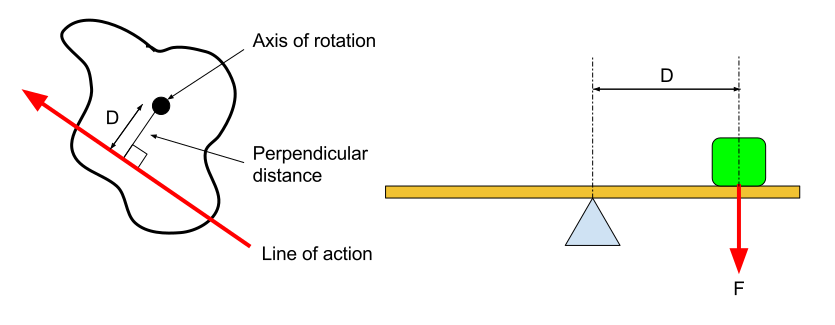
The units for the moment of a force are $\units{Nm}$. The moment of a force is sometimes called torque.
The calculation of a single moment is very simple, but it is when two or more moments or forces interact that it gets more complicated. Using moments can be a very powerful tool to help solve problems involving equilibrium. The phrase “perpendicular distance from the point of rotation” is very important, and is what catches many students out. In some instances, as below, it may even be necessary to resolve the force into components.

In the example above the weight of the bar ($mg$) is acting straight down, the line of action is shown by the black dashed line. Because the bar is uniform, its centre of mass is in the middle of the bar, and this is where we assume the weight ot act from. The perpendicular distance to the axis of rotation is just measured along the bar and is clearly half the length of the bar.
The tension is a little harder to deal with. We could extend the line of action right back until a line can be drawn at 90 ° which passes through the axis of rotation, but fortunately there is a much simpler approach. If we resolve the tension into a component perpendicular to the bar we can then use the length of the bar to find the moment of force it provides.
As this bar is in equilibrium we can now apply the principle of moments to find any unknown values.
The Principle of Moments
The principle of moments is very important, as it describes how moments interact when there is equilibrium. You must learn it!
For an object in equilibrium the sum of clockwise moments equals the sum of anticlockwise moments about the same point.
Using the example above we can see how we would apply the principle of moments:
- Identify and calculate the known moment. In this case we may already know the weight of the bar. This would be the anticlockwise moment.
- As we know the system is in equilibrium this value for the anticlockwise moment (M-bar) is also the value for the clockwise moment. We can now calculate the value for the component of the force (F) acting perpendicular to the bar.
- We can now calculate the value of T.
Almost all moments problems can be solved using this method, and in fact the example just described is harder than most that you will encounter.
It is important to select an appropriate point around which to resolve the forces. If a forces passes through the point chosen it will have no moment about that point as $d=0$.
Couples
If a single force is acting it will generally cause a rotation and movement in the direction of the force (translation).
If pure rotation is required two equal and opposite forces should be applied to the object acting along parallel but different lines.
This is called a couple.
In a couple the two forces have the same value and we use the distance between the forces and not the distance to the pivot to calculate its value.
Sometimes a single force is applied but a resistive force is offered by the pivot of the object, examples could be a spanner loosening a nut or pushing a roundabout in a playground.