
3.4.1.4 Projectile motion
Independent effect of motion in horizontal and vertical directions of a uniform gravitational field. Problems will be solvable using the equations of uniform acceleration.
Qualitative treatment of friction.
Distinctions between static and dynamic friction will not be tested.
Qualitative treatment of lift and drag forces.
Terminal speed.
Knowledge that air resistance increases with speed.
Qualitative understanding of the effect of air resistance on the trajectory of a projectile and on the factors that affect the maximum speed of a vehicle.
Projectile motion
So far, we have looked at motion in only one direction, either horizontal or vertical. When the motion is horizontal the acceleration depends on the force applied, whereas, vertical motion (free fall), the only force is that due to gravity so an object close to the Earth's surface will always accelerate at 9.81 ms-2 (when we neglect air resistance).
But what about when an object has both horizontal and vertical components to its motion? For example when a lemming takes a running leap of the edge of a cliff.
As soon as it leaves the edge of the cliff it no longer has any horizontal acceleration and the only force acting on it is its weight.
Remember that a force only acts whilst the lemming’s little paws are in contact with the ground. When there is no contact it no longer accelerates horizontally. It accelerates downwards because weight is a non contact force.
The lemming will still have a horizontal velocity but its initial vertical velocity will be 0, but will instantly begin to increase. In the absence of air resistance the horizontal component of the velocity remains unchanged, but the vertical component begins to increase. This means we can treat the horizontal and vertical components of the lemming's motion independently.
As velocity is a vector we should give it direction coordinates, let’s make upwards +.
When looking at the motion of our lemming we find that its horizontal velocity will determine the range of its ill-fated flight but not the length of time that it is airborne.
We already know that all objects fall at the same rate so the time of the flight is determined by the height above the ground. This can be shown by using the suvat equations.
We know that:
where s is the vertical distance above the ground, the initial vertical component of the velocity, u=0 and a=g (as g acts downwards we write -g) so the time of the flight is:
This means that the length of time our projectile (lemming) is in the air is directly proportional to the square root of the height on the cliff. So if the time of flight is determined by the height of the cliff, what determines the range of the lemming?
The range is determined by the horizontal component of the velocity and the time of the flight therefore is simply:
where v is the horizontal velocity. The horizontal velocity remains constant throughout the flight.
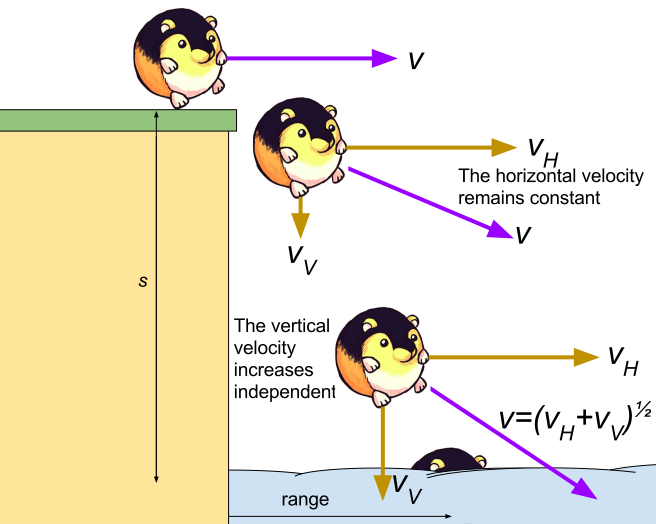
We can of course calculate the velocity of our poor lemming as it hurtles into the ground below the cliff. The horizontal velocity is constant throughout its flight, but its vertical velocity increases according to:
as it is accelerating downwards and we have set that direction as negative we should write:
This will equal -v as the velocity will also be downwards. You can now just use Pythagoras to calculate the resultant or instantaneous velocity. It follows that the angle of its impact with the sea is:
Remember the choice of directional coordinates is completely arbitrary.
Not everything in life is as simple as lemmings. Imagine a flare gun fired at 26ms-1 from ground height at an angle of 30° to the horizontal. Like all projectiles in the absence of air resistance, the flare traces out a parabolic path. Now the initial velocity has a vertical and horizontal component. We will need to resolve it to find them individually.
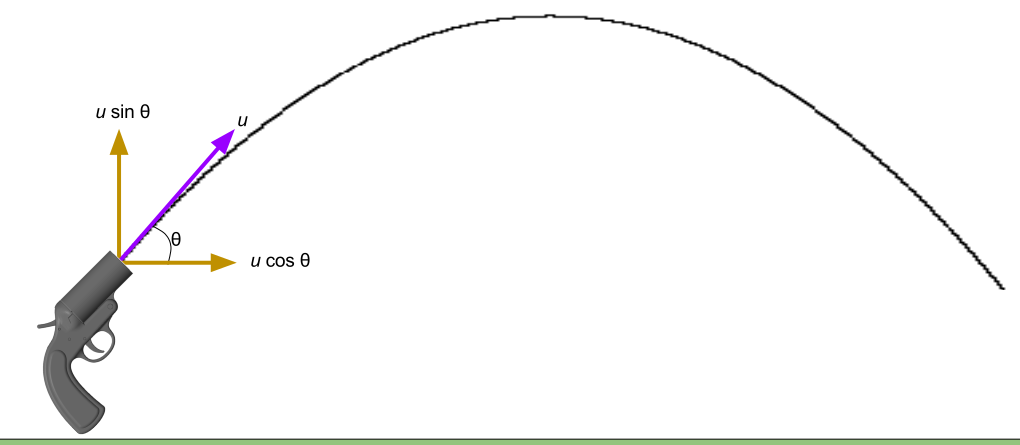
Once the velocity has been resolved you can just use the suvat equations as before. Remember that it is the vertical component that determines the time of the flight and vertical distances whereas the horizontal component determines the range.
In this case the flare will reach its maximum height when the vertical component of the velocity equals 0. This will be after the amount of time which equals
Note that this is not the time of flight, but just the time to reach the maximum height.
This is the maximum height of the flare. We said earlier that the range is s=vt, but in this case the calculated value for t equals half of the flight time. Think carefully about how we could calculate the maximum height of the projectile and the range of the projectile.
This example of the flare gun is an interesting one, as it would not follow a fully parabolic path. It would explode at the top of its flight, which involves a lot of interesting energy and momentum changes, and the remains would fall with significant air resistance.
It is worthwhile thinking about the shape of the path that a projectile would take if there was a significant amount of air resistance.