
3.6.1.3 Simple harmonic systems
Effects of damping on oscillations.
Damping
All oscillators experience friction. This frictional force will eventually reduce the amplitude of- the oscillations down to zero. However over a short period of oscillations the amplitude does not change so we can discount friction.
Within the oscillator, energy is constantly being transferred between kinetic and potential energy. Overall the total amount of energy in conserved.
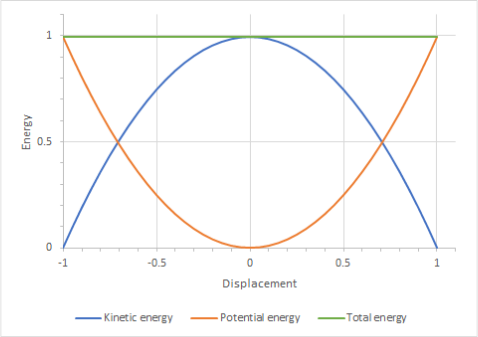
$$\large Total\;energy=E_{k}+E_{P}$$The potential energy of the oscillator will be 0 when it is at its equilibrium position, where it has its maximum velocity. The potential energy will be maximum where the displacement x is maximum. The graph on the right shows how potential energy and kinetic energy vary with displacement. The curves are parabolic in shape and their sum is always the total energy.
$$E_{k}=\frac{1}{2}mv^{2}$$The energy stored (potential energy) in a spring is,
$$E_{P}=\frac{1}{2}ke^{2}$$Where x is the displacement from equilibrium, and k is the spring constant.
The total energy of the system is equalt to the maximum energy stored when the spring is fully displaced at its amplitude,
$$E_{T}=\frac{1}{2}kA^{2}$$Using this we can show that the kinetic energy of the oscillating spring is,
$$\large E_{k}=E_{T}-E_{P}=\frac{1}{2}k\left(A^{2}-x^{2} \right )$$It is clear that the energy in an oscillator is constantly being transferred between potential and kinetic energy. When it is moving fastest, as it passes through the equilibrium, position, the Ek is maximum, and Ep is minimum. When the oscillator is at the maximum displacement then the Ek is minimum, and Ep is maximum. The total energy, for a free oscillator remains constant.
Damped Oscillations
When an object oscillates it will lose energy to frictional forces, eventually the oscillations will diminish to zero. This is usually due to air resistance, by a large surface area to mass ratio or by the oscillator being immersed in a viscous fluid.
Often the decay is proportional to the velocity of the oscillator, which leads an exponential decay in the amplitude.
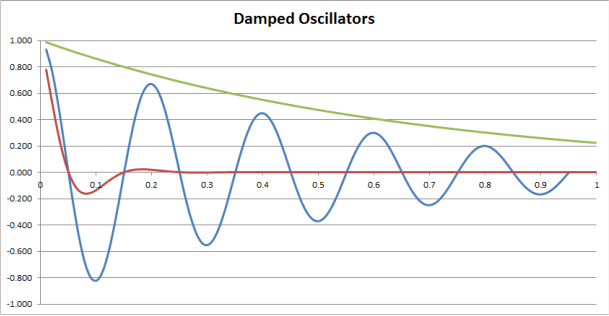
- Light damping (blue line) is when the amplitude of each oscillation is fractionally less than the previous one. All practical oscillators, such as springs and pendulums are in fact lightly damped, and each oscillation is slightly smaller. The amount the oscillation is reduced by is called the damping constant.
- Critical damping (red line) This is when the oscillations return to equilibrium in the shortest possible time. It is used when an oscillating system is not desirable, e.g. suspension systems, compass needles.
- Heavy damping (green line) is when the oscillator very slowly returns to the equilibrium position.
Damping oscillators can be very important, especially if that system can easily be made to resonate. These systems, such as bridges or car suspensions need to be damped to protect the structures and the users.
As the damped system has a decaying amplitude, it can be described using a decay equation such as:
$$\large A=A_{0}e ^{-\lambda t}$$Where λ is the decay constant. The greater the decay constant the greater the amount of damping. The decay constant can be found by taking natural logs of both sides of the equation and plotting a graph of ln(A) against ln(t). You will carry out an investigation into this in class.

An example of a damped oscillator
The video below shows a demonstration of how the exponential decay of an oscillating system can be verified