
3.7.1 Fields
Concept of a force field as a region in which a body experiences a non-contact force.
Students should recognise that a force field can be represented as a vector, the direction of which must be determined by inspection.
Force fields arise from the interaction of mass, of static charge, and between moving charges.
Similarities and differences between gravitational and electrostatic forces:
Similarities: Both have inverse-square force laws that have many characteristics in common, eg use of field lines, use of potential concept, equipotential surfaces etc
Differences: masses always attract, but charges may attract or repel
Intro
We are all familiar with non-contact forces like magnetism and weight acting at a distance. You will already have learnt that sometimes these forces can be explained by exchange particles, but often that explanation doesn’t help us describe the situation, or the effects that we are seeing very clearly. The most comprehensive explanation can be given by describing the force as a field, so what do we mean by a field in physics?
Force fields as a region of space
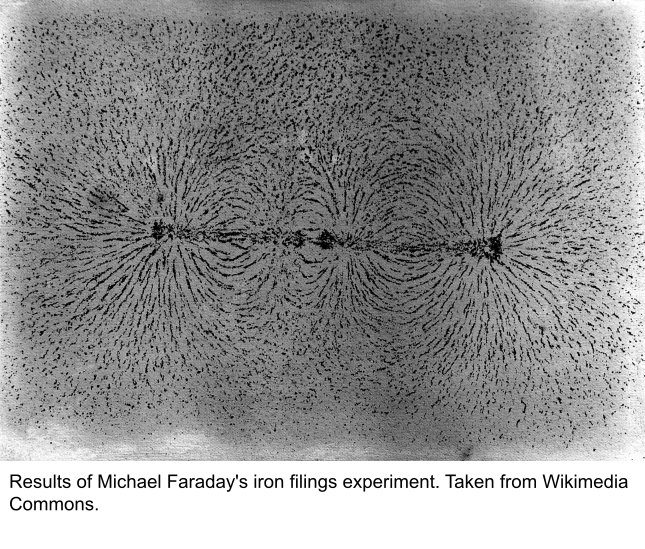
A force field is a region of space where an object experiences a non-contact force. The idea of fields was first introduced by Michael Faraday in the mid-19th century to explain how forces such as electricity and magnetism could act at a distance. Originally, fields were considered to be purely abstract mathematical tools, but we now consider fields to be physically real, and exist in space even when no object is present. This is because fields carry both energy and momentum, and take a finite time to propagate from place to place — light from the Sun, for example, takes around eight minutes to reach the Earth, carrying its energy across empty space via the electromagnetic field rather than instantaneously. If forces really did act instantaneously at a distance, there would be nothing left to “carry” in between; the fact that fields propagate at a finite speed, and that this propagation can be measured directly (as radiation pressure, for instance, when light pushes on a surface it strikes), is some of our best evidence that fields are physically real rather than just a useful mathematical bookkeeping trick.
Fields are used to explain interactions of the gravitational force, the electric force, and the magnetic force. Most fields have very similar properties, and as you can see below, the electric field and the gravitational field have several analogous qualities.
Some important terminology to learn right at the outset relates to what a field acts on and the direction in which it acts. We describe the object that creates the field in question as the source object. In the case of a gravitational field the source object would be any object with mass, in the case of an electric field the source object would be an object with electric charge, and for a magnetic field it would be a current.
A test object is a second object that interacts with the field, and not directly with the source object.
Field lines and vector representation
As described above, fields have both size and direction which make them vectors. Therefore we must always think about the direction the force, and the field is acting. We always define the direction of that force as being the direction the test mass would accelerate. We can represent a field using a field line diagram, often we think about the field originating at a point mass, which is a mass infinitesimally small. The field from a point source is a radial field, which expands outwards in all directions as in Figure 2.
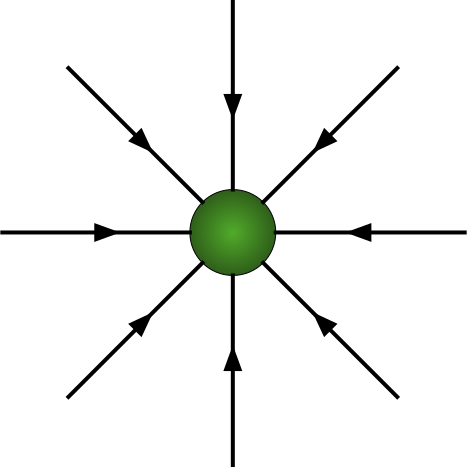
The arrow heads on the field lines show the direction of the force on a positive test charge (electrostatic) or a test mass (gravitational). Gravitational forces are always attractive, so the field lines on a gravitational field diagram would always point towards the source mass. The shape of the diagram also shows the strength of the force, the closer together the lines, the stronger the force. Most simple fields show straight lines, but when two objects interact the force lines may not be straight, and in that case, the direction of the force would be a tangent to the line at that point. Lines on a field diagram never cross as each point in space has exactly one field direction.
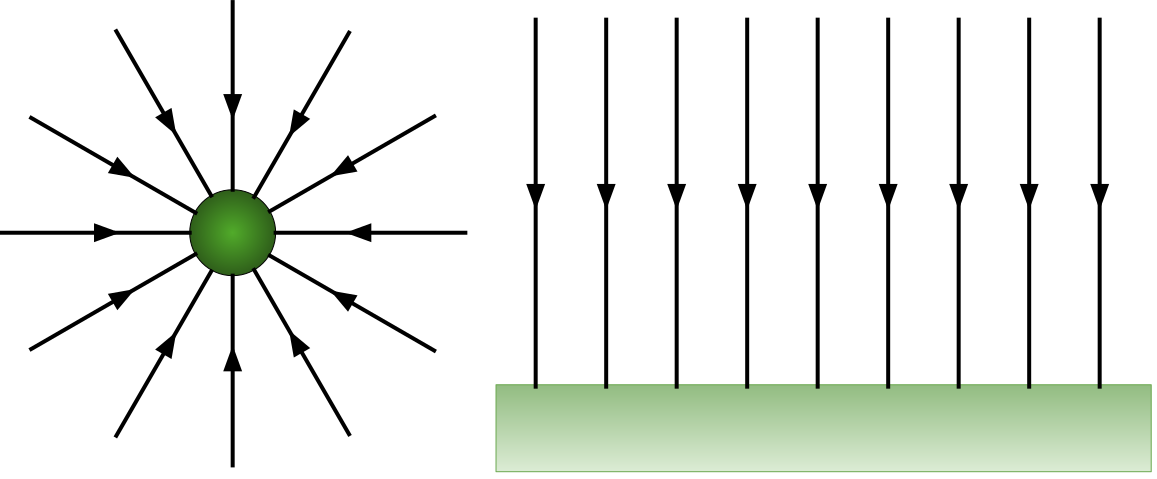
Fields can either be radial or parallel, the field around a point mass, or point charge, or even a planet are radial, which means that the strength of the force decreases as distance increases, represented by the fact that the distance between the field lines increases with distance. Parallel fields can be found between two charged electric plates for example, or close to a large body with mass, such as a planet. When field lines are parallel the strength of the field does not change.
Where fields come from (mass, static charge, moving charges)
All non-contact forces can be explained by fields, but different types of force create different fields, produced by different kinds of source object.
- Objects with mass create gravitational fields. Because mass can only ever be positive, gravitational fields are always attractive, so the arrows on a gravitational field diagram always point towards the source mass — whether that’s the Earth pulling on the Moon, or the Sun’s field holding an entire solar system in orbit, exactly the same force is at work across vastly different scales.
- Charged objects create electric fields. Because charge can be either positive or negative, electric fields can be either attractive or repulsive: the field lines around an isolated charge point away from a positive charge and towards a negative one, since that’s the direction a small positive test charge would be pushed or pulled.
- Moving charges, such as the electrons flowing as an electric current, create magnetic fields. A stationary charge produces no magnetic field at all; it’s specifically the motion of charge that matters, which is why a plain wire only becomes magnetic once current starts flowing through it. We’ll look at magnetic fields, and how they interact with moving charges, in much more detail in a later topic.
It’s worth noticing that of the three, gravity is by far the weakest force, even though it’s the one we’re most aware of day-to-day. We only notice it because the Earth beneath our feet has such an enormous mass; at the scale of individual particles, electric forces completely dominate, as the next section shows.
Gravitational and electric fields compared
Historically, these two force laws were discovered a century apart — Newton published his law of gravitation in 1687, while Coulomb’s law for the electrostatic force wasn’t confirmed experimentally until 1785 — yet they turned out to share an identical mathematical form, both following an inverse-square relationship. This shared structure is part of what makes fields such a powerful unifying idea in physics: two forces that seem completely unrelated in everyday experience, one holding you to the ground and the other making a balloon stick to a jumper, are described by essentially the same mathematics.
The two forces differ enormously in strength, however. Between a proton and an electron in a hydrogen atom, the electrostatic force is around $10^{39}$ times stronger than the gravitational force between them — a difference so vast that gravitational effects are simply ignored in atomic and particle physics. Gravity only becomes significant when very large masses are involved, which is why it dominates on the scale of planets and stars, while electric forces dominate everywhere from chemical bonding to the structure of the atom itself.
As all fields are real throughout space, they all have similar properties such as:
| Similarities |
|---|
| Both follow an inverse-square law: $F \propto 1/r^2$ |
| Both can be represented by field lines |
| Both use the concept of potential |
| Both have equipotential surfaces |
| Force laws share the same mathematical form |
But as they act on different types of object, there are also key differences:
| Key difference |
|---|
| Mass always attracts — no repulsion |
| Charges can attract or repel depending on sign |
| No 'negative mass' — but positive and negative charges exist |
| G is tiny; electrostatic forces dominate at small scales |
Comparing electric fields and gravitational fields side by side:
| Concept | Gravitational | Electrostatic |
|---|---|---|
| Force per 'something' | Force per unit mass ($N kg^{-1}$) | Force per unit charge ($N C^{-1}$) |
| Inverse-square law | $F \propto 1/r^2$ (Newton) | $F \propto 1/r^2$ (Coulomb) |
| Potential | Gravitational potential $V$ | Electric potential $V$ |
| Energy landscape | Objects fall into potential wells | Charges move toward lower potential |
Worth remembering
Because gravitational forces are always attractive, an object always has to do work against gravity to increase its separation from a source mass — this is why gravitational potential energy is always taken to be negative, rising towards zero as separation increases. Electric potential energy doesn’t have to follow this pattern, since it can be positive or negative depending on whether the two charges involved attract or repel.
Common exam mistake
It’s tempting to assume that because gravitational and electrostatic forces share the same $1/r^2$ form, they can be treated identically in every calculation — but the constants are different ($G$ versus $\frac{1}{4\pi\varepsilon_0}$), and so are the sign conventions. A common error is applying Coulomb’s law reasoning, such as repulsion between two like charges, to a gravitational situation, or forgetting that a gravitational field diagram can never show diverging field lines the way an electric field diagram sometimes can. Always check which type of field a question is describing before deciding whether attraction, repulsion, or attraction only, is possible.
Test yourself
Try the questions below to check your understanding of this topic. Numerical questions use different numbers each time, so you can attempt them more than once.