
3.6.1.1 Circular motion
Motion in a circular path at constant speed implies there is an acceleration and requires a centripetal force.
Magnitude of angular speed,
Radian measure of angle.
Direction of angular velocity will not be considered.
Centripetal acceleration,
The derivation of the centripetal acceleration formula will not be examined.
Centripetal force,
Once the basics of circular motion have been grasped, it is important to be able to apply them to a range of situations. One of the best ways to do this is to look at some different examples and see what is providing the centripetal forces and how they change around the circular path.
The Bucket Trick
Water can be made to stay in an inverted bucket if it is spun faster than a certain minimum speed. This is because below this speed the water will fall because its weight will accelerate it at 9.81ms-2. If it is rotated at an angular speed great so that the centripetal acceleration is equal to or greater than its free-fall acceleration, then at the top of the path the water will accelerate downwards at at least the same rate as the bucket.
When the bucket revolves faster than this rate the floor of the bucket pushes down on the water and provides it with enough centripetal acceleration to move in the same circular path as the bucket.
Common exam mistake
This inequality only works because, at the critical (minimum) speed, the bucket's push on the water drops to exactly zero — gravity alone is providing all of the centripetal force at that boundary case. At any speed above this, the bucket floor also contributes a push, and you can't simply set $a=g$ any more. Don't apply $r\omega^2=g$ to a general "spinning water" problem — it's only valid right at the critical minimum speed.
This is the same principle that is used to create artificial gravity in fairground rides and in (potential) space stations. For a space station to create artificial gravity it would need to rotate with a centripetal acceleration of 9.81ms-2, so:
So for a space station with a radius of 100m would give an angular velocity of 0.31rad s-1 and a period of revolution of 20s. The larger the space station, the slower it would have to rotate. There are, obviously lot of other practical considerations about building a space station like this, such as the huge mass.
Cars Going Over Hills
When a car is travelling on a flat road, the support force from the road is in the opposite direction to and equal in magnitude to the weight of the car. When the car goes over a hill the centripetal force which causes the car to travel in a circular path is the difference between the weight and the support force.
Common exam mistake
Centripetal force always points towards the centre of the circular path — here, that's downwards, into the hill. Since weight (down) must be larger than the support force (up) to give a net downward resultant, the equation is $mg-S=\frac{mv^2}{r}$, not $S-mg=\frac{mv^2}{r}$. Getting this sign the wrong way round is a very common error and leads to the wrong final formula for the maximum speed.
The faster the car goes, the greater required centripetal force. As the car’s weight is providing the centripetal force, then as the car gets faster then S must get smaller and smaller until it reaches 0. When S reaches 0 the car will lose contact with the road when the speed of the car reaches v0.
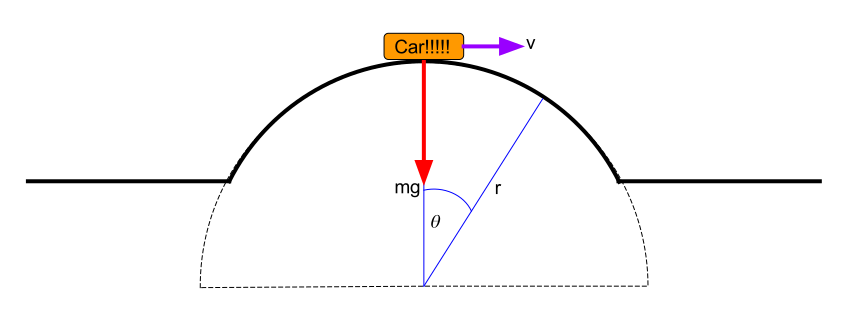
So for a bridge, with a radius of r the maximum speed the car would be able to go before it became airborne would be:
Going Round Bends
Cycle tracks have banked corners to allow the bikes to remain at high speeds as they go around the bends. Of a flat surface the centripetal force is provided by the frictional forces between the tyres and the road. When the track is banked, the support force from the surface provides some of the centripetal force, so less has to be provided by the friction.
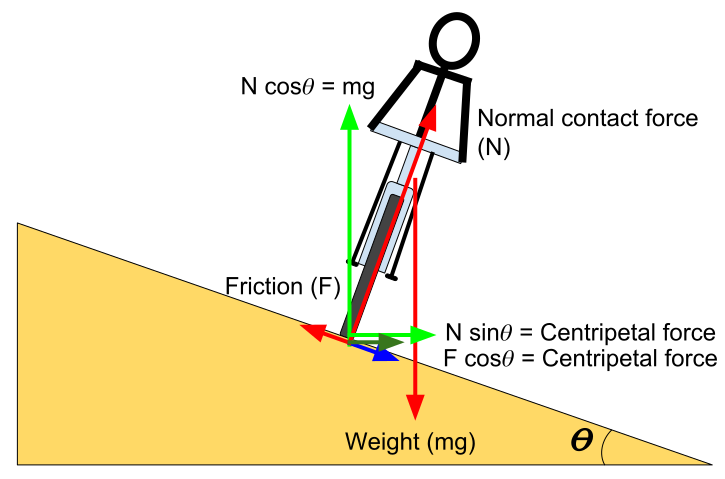
Resolving horizontally $N \sin \theta+F\cos\theta=\frac{mv^{2}}{r}$ is the centripetal force acting on the car.
Resolving vertically $N \cos \theta=mg$ as it is opposite the weight.
Common exam mistake
It's easy to swap $\sin\theta$ and $\cos\theta$ when resolving $N$. Here $\theta$ is measured from the vertical (the normal to the banked surface), so the component of $N$ balancing weight — which acts straight down — uses $\cos\theta$, and the horizontal component providing centripetal force uses $\sin\theta$. Always sketch the angle onto your diagram and check which component points which way, rather than guessing which trig ratio to use.
At a certain speed the bike could travel around the track with no friction, in this case:
So the speed the bike would need to be travelling at for there to be no sideways friction is $v^{2}=gr\tan\theta$
Common exam mistake
$\tan\theta=\frac{v^2}{gr}$ only holds at the one specific speed where friction isn't needed at all. At any other speed on the same banked track, friction also contributes to (or opposes) the centripetal force, and this simplified equation no longer applies — you'd need to go back to the full horizontal and vertical resolving equations with an $F$ term included.
Test yourself
Try the questions below to check your understanding of this topic. Numerical questions use different numbers each time, so you can attempt them more than once.