
On this page:
3.1.1 Use of SI units and their prefixes
Fundamental (base) units.
Use of mass, length, time, quantity of matter, temperature, electric current and their associated SI units.
SI units derived.
Knowledge and use of the SI prefixes, values and standard form.
The fundamental unit of light intensity, the candela, is excluded.
Students are not expected to recall definitions of the fundamental quantities.
Dimensional analysis is not required.
Students should be able to use the prefixes:
T, G, M, k, c, m, µ, n, p, f,
Students should be able to convert between different units of the same quantity, eg J and eV, J and kW h.
Units
Physics, and in fact all science is based on measuring the world around us. To make it possible to communicate measurements, and discoveries, some basic units need to be defined, so that we know a metre measured in this country is the same as a metre in another. These basic units, called SI base units define dimensions such as length, time, mass etc. They are agreed internationally, and have very rigorous definitions.
You do not need to know the definitions of the SI base units, but I have included them in the table below for interest. You will encounter and use them all except the candela, which is not needed in the A Level course.
| Dimension | Unit | Symbol | Definition | |
|---|---|---|---|---|
| Length | metre | m | The metre is the length of the path travelled by light in vacuum during a time interval of 1/299792458 of a second. | Find out more |
| Mass | kilogram | kg | The kilogram is defined by fixing the numerical value of the Planck constant, h, at exactly 6.62607015×10⁻³⁴ J s. | Find out more |
| Time | second | s | The second is the duration of 9192631770 periods of the radiation corresponding to the transition between the two hyperfine levels of the ground state of the caesium-133 atom. | Find out more |
| Electric current | ampere | A | The ampere is defined by fixing the numerical value of the elementary charge, e, at exactly 1.602176634×10⁻¹⁹ C. | Find out more |
| Temperature | kelvin | K | The kelvin is defined by fixing the numerical value of the Boltzmann constant, k, at exactly 1.380649×10⁻²³ J K−1. | Find out more |
| Amount of substance | mole | mol | The mole is defined by fixing the number of elementary entities in one mole, the Avogadro constant NA, at exactly 6.02214076×10²³ mol−1. | Find out more |
| Luminous intensity | candela | cd | The candela is the luminous intensity, in a given direction, of a source that emits monochromatic radiation of frequency 540×1012 hertz and that has a radiant intensity in that direction of 1/683 watt per steradian. | Find out more |
Worth remembering
The definition of the kilogram above is not the one you may have seen in older textbooks. Until May 2019, the kilogram was defined as the mass of a physical platinum-iridium cylinder kept in Paris — the last SI unit still tied to a real object rather than a constant of nature. It was retired in favour of the Planck constant definition shown here, alongside similar changes to the ampere, kelvin and mole, so that every SI unit is now fixed by an unchanging property of the universe rather than an artefact that could, in principle, gain or lose a speck of dust.
Once these seven base units have been defined it is then possible to derive all other units using these. You will be expected to be able to show units are derived, and as such how different ways of expressing units are similar. For example the newton is defined by $F=ma$. This equation contains mass, which is a base unit, and acceleration, which itself is metres divided by seconds squared, so the newton is:
Any other equation that has the same units must therefore also represent a force.
Common exam mistake
When asked to show that two sides of an equation have the same units, don’t stop at a derived unit such as newtons or joules — break everything all the way down to the seven base units (kg, m, s, A, K, mol, cd). Two expressions can look completely different in derived units while actually being identical once reduced to base units, and that reduction is exactly what the examiner is checking you can do.
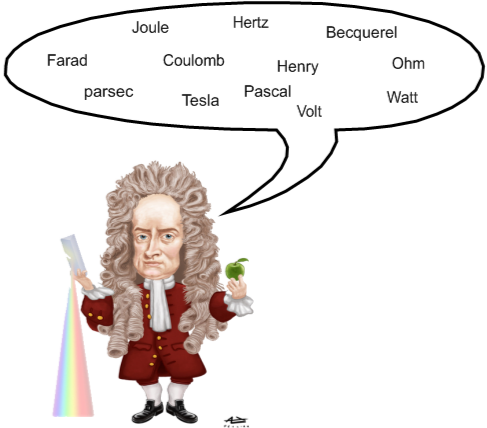
Some of the SI derived units you will need to know are:
- newtons
- joules
- watts
- volts
- coulombs
You will also need to be able to convert from non-standard units or non-SI units into standard SI units. For example the electron volt ($\units{eV}$) is equal to $\quantity{1.60\times 10^{-19}}{J}$, so $\quantity{3}{eV}$ is equal to $\quantity{4.8\times 10^{-19}}{J}$. Some of the non-standard units you will meet are:
- electron volt
- kilowatt-hour
- kilometres per hour
- light-year
- parsec
Big and small numbers
Often in Physics we have to calculate with either very large or very small numbers. Numbers with lots of trailing or preceding zeros can be very difficult to deal with, so it is usual to use either standard form, or scientific notation. You should be familiar with standard form and most of the prefixes used, but it is worth refreshing them.
| Exponent | Prefix |
|---|---|
| 10-9 | nano (n) |
| 10-6 | micro (μ) |
| 10-3 | milli (m) |
| 103 | kilo (k) |
| 106 | mega (M) |
| 109 | giga (G) |
Common exam mistake
Prefixes are case-sensitive, and it’s an easy way to lose marks — milli (m) and mega (M) differ by a factor of 109, so writing 5 mA when you mean 5 MA is not a small slip. Micro (μ) and milli (m) get muddled just as often. Always double-check which case you’ve written, especially when copying a prefix from a data sheet or calculator display.
In the example below the calculation produces a small answer, which is correctly stated to 2 significant figures. This answer is correct but it is untidy, and if the answer were much smaller than this it would be hard to read. The second answer, in standard form is much better as it is easier to read, and is easier to compare to other values. The last answer written with a prefix is the best way to write a final answer.
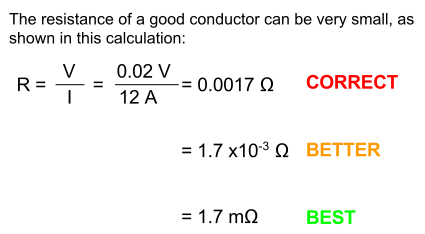
I would encourage you to not round any intermediate steps in calculations, although if you need to write them out, give them in standard form. The answer given at the end of the question should use a prefix if necessary; although you won’t lose marks for giving it in standard form you could lose marks for writing it out in full.
Common exam mistake
Rounding a value part-way through a multi-step calculation, then using that rounded value in the next step, introduces an error that grows with every step that follows — and it can shift your final answer enough to fall outside the accepted range in a mark scheme. Keep the full, unrounded value (or several extra significant figures) on your calculator right through to the last line, and only round once, at the very end.