
3.7.2.4 Gravitational fields
Orbital period and speed related to radius of circular orbit; derivation of T^2 is proportional to r^3.
Synchronous orbits.
Use of satellites in low orbits and geostationary orbits, to include plane and radius of geostationary orbit.
Orbital motion as circular motion under gravity
We have talked a lot about astronauts and objects in space, and we have also described gravity as being a purely attractive force, but how can we reconcile these two ideas? How can an object remain in space despite the attractive pull of gravity?
Well, the key idea is combining what we have learnt about the force of gravity with what you have studied in mechanics. An old thought experiment called Newton’s cannon is good at illustrating this. Imagine a cannon ball fired from the barrel of a cannon. The cannon ball falls like a projectile under the influence of gravity, and its range is determined by the speed of the cannon ball and the initial height of the cannon.
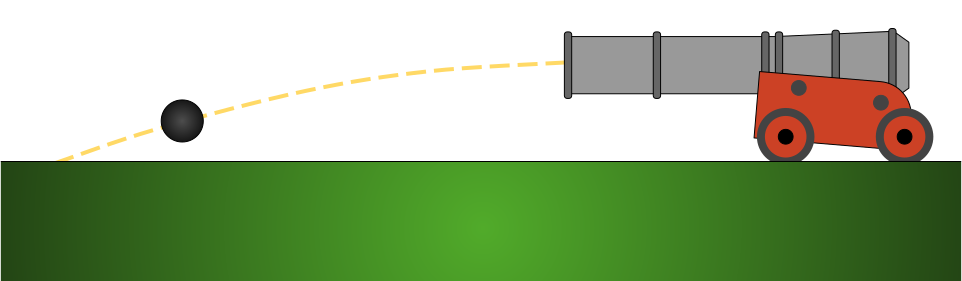
If the ground beneath the cannon is flat, then the range of the cannon ball can be increased by increasing its speed. However, the ground is not entirely flat, and curves away underneath the cannon ball. In reality, as the speed of the projectile increases, its range increases not only because it is travelling faster, but also because the ground curves away beneath it.
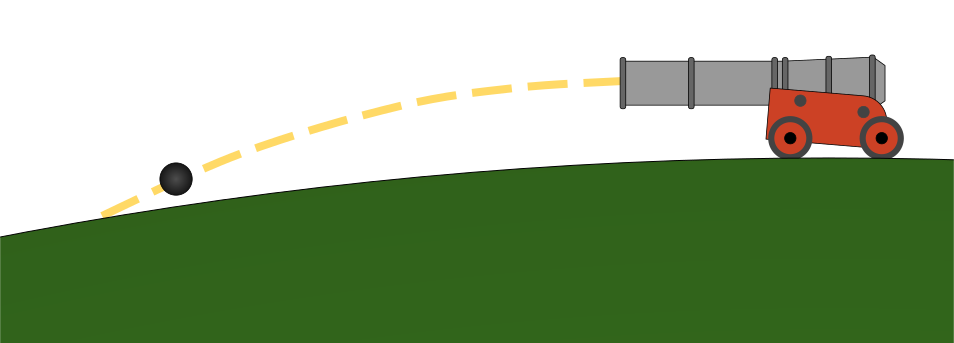
At even greater speeds, the cannon ball falls just as fast, but travels significantly further around the globe before it hits the ground, since the Earth’s curve continues to fall away beneath it.
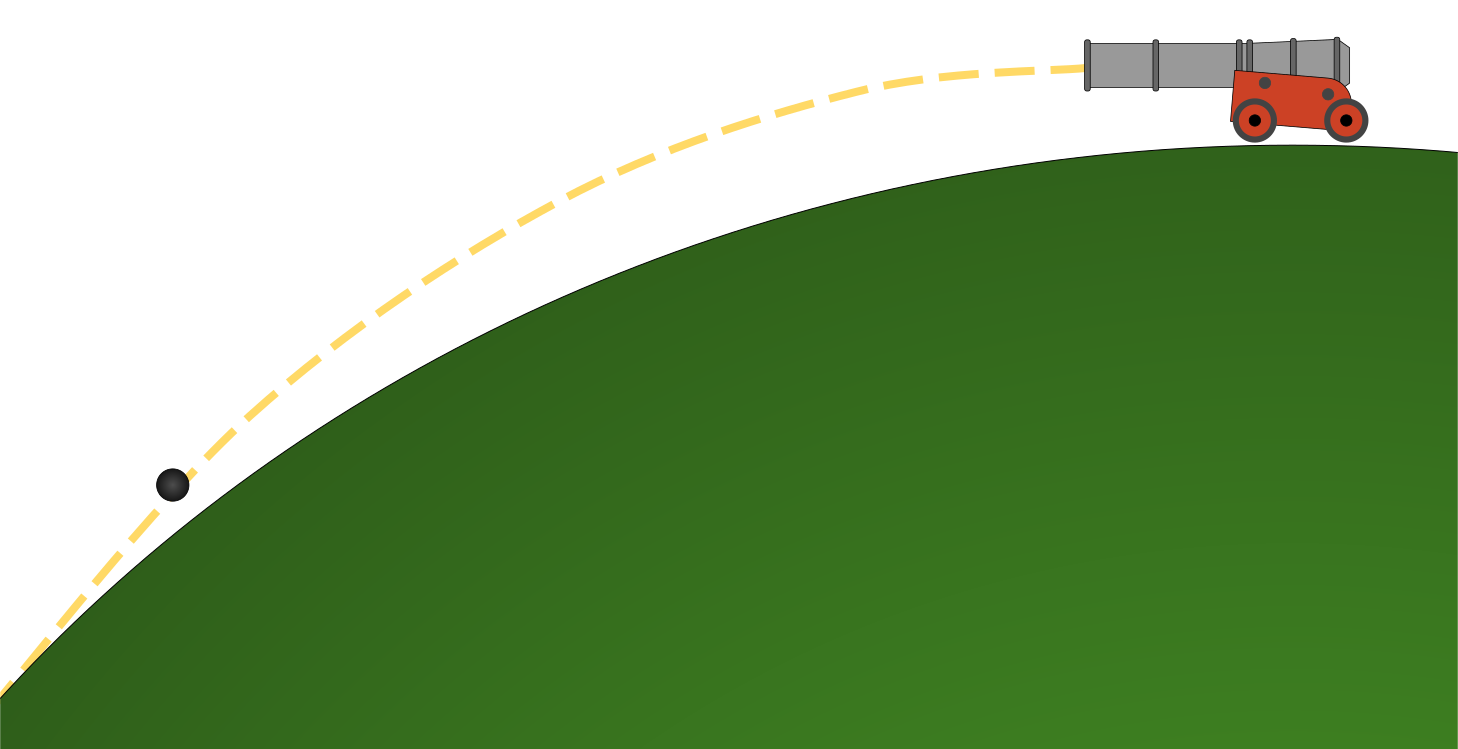
Eventually, the cannon ball will be fired at a great enough speed that, as it falls, the Earth’s curve drops away at exactly the same rate. Ignoring air resistance, it will therefore never land — instead it goes into orbit, eventually returning to the cannon. All the time, the cannon ball is falling under the influence of gravity, so any object orbiting another is in fact in free-fall around it.
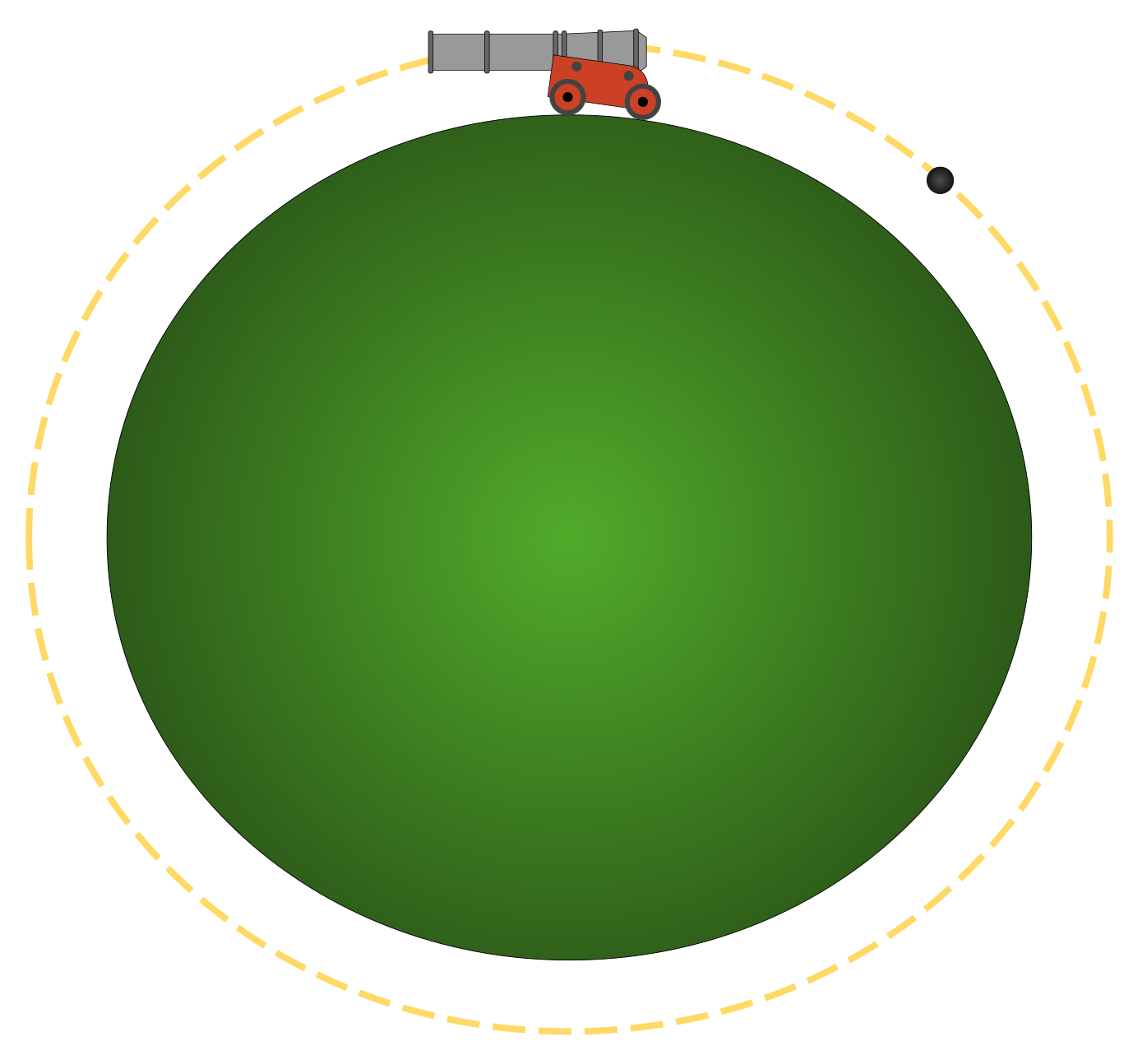
Gravity acts on all masses regardless of their speed — it is not gravity that changes, only whether the object curves enough to stay in orbit rather than escaping or crashing. Looking at the diagram below, we can see that the satellite has a horizontal velocity. Without gravity, it would travel in a straight line off into space. Gravity pulls the satellite toward Earth’s centre, providing a centripetal force. This changes the direction of the velocity and creates a circular orbit; the forward motion and the centripetal force balance perfectly. The satellite keeps ‘missing’ the Earth as it falls toward it. Effectively, the satellite is in continuous freefall: it accelerates toward Earth constantly, but its tangential speed means it keeps missing the surface.
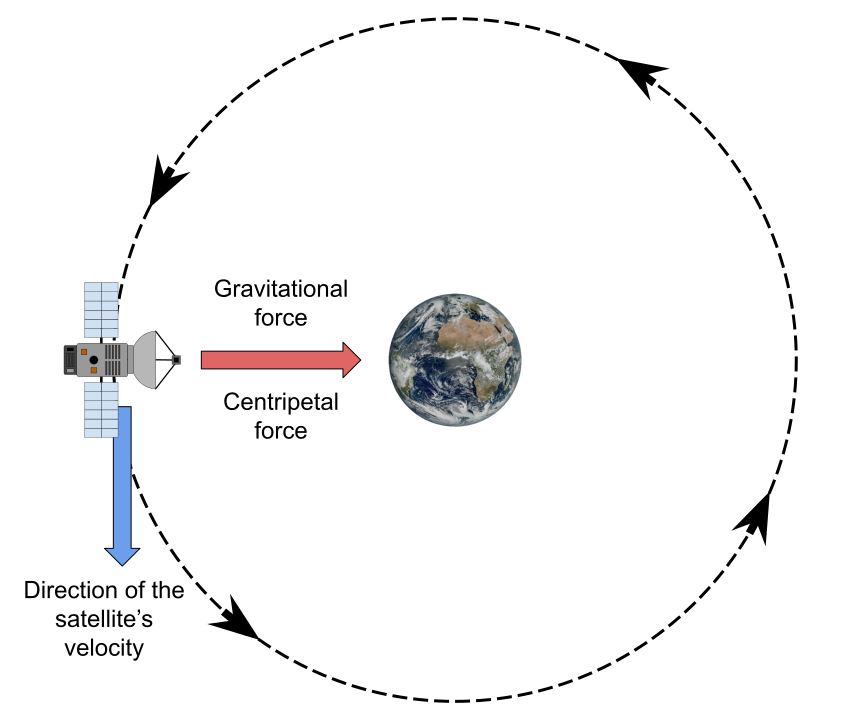
This is why astronauts in orbit around the Earth appear to be weightless, despite $g$ still very much acting on them — we calculated $g\approx8.7\units{N kg^{-1}}$ for a similar altitude in the previous topic: $$g=\frac{GM}{r^{2}}=\frac{6.67\times10^{-11}\times6.0\times10^{24}}{(6770\times10^{3})^{2}}=8.7\units{N kg^{-1}}$$ They are constantly falling around the Earth, with the centripetal force provided entirely by gravity.
Orbital speed from gravitational force = centripetal force
We can apply the ideas we have already met in the Periodic Motion topic, specifically circular motion, to an object in a gravitational orbit.
$$\begin{aligned} \text{Centripetal force} &= \text{Gravitational force} \\ \frac{mv^2}{r} &= \frac{GMm}{r^2} \end{aligned}$$ As gravity from the Earth is providing the centripetal force, we can equate the two equations. The mass of the satellite $m$ cancels out on both sides, and the equation can be re-arranged to make $v$ the subject.
$$ \begin{aligned} v^2 &=\frac{GM}{r} \\ \\ v &= \sqrt{\frac{GM}{r}} \end{aligned} $$
Worth remembering
It is important to remember that centripetal forces are adjectival forces, so can always be described in terms of another force — in this case it is the gravitational force.
So what does this equation tell us? A bigger $GM$ leads to a larger $v$: a satellite must move faster to maintain orbit around a heavier planet or object. So, to maintain an orbit around the Sun, a satellite would need to be moving at a greater speed than it would to orbit the Earth at the same distance.
It is also useful to see the equation in this form: $$v^2=GM\left(\frac{1}{r}\right)$$
This more clearly shows the inversely proportional relationship between the square of the speed and the radius of the orbit. For every radius from the Earth, there is a specific speed that will hold the object in that orbit; a larger radius $r$ needs a smaller speed $v$, so satellites in higher orbits move more slowly. Notice too that the satellite’s own mass, $m$, cancelled out of the equation entirely — just as with $g$ itself, orbital speed does not depend on the mass of the orbiting object. All objects at radius $r$ orbit at the same speed. This is not necessarily intuitive! ‘Higher orbit means slower speed’ feels wrong — we need more energy to reach a higher orbit, yet the satellite ends up slower.
For a satellite in a low Earth orbit of 1000 km above the surface ($r=1000+6370=7370\units{km}$), its orbital speed would be:
$$ \begin{aligned} v &=\sqrt{\frac{6.67 \times 10^{-11} \times 6.0 \times 10^{24}}{7.370 \times 10^{6}}} \\ \\ v &= 7.4 \times 10^{3} \units{m s^{-1}} \end{aligned} $$
Common exam mistake
The most common error in this kind of calculation is using the altitude above the surface directly as $r$, forgetting that $r$ must be measured from the centre of the Earth. Always add the Earth’s radius (about $6370\units{km}$) to the given altitude before substituting into the equation.
This is where it is worth considering the rather unintuitive idea we introduced earlier, ‘higher orbit means slower speed’. Let’s work through the physics in a qualitative way. If a spacecraft in the orbit described above fires its thrusters, what would happen? Well, if its speed increases, its kinetic energy would also increase. Considering the forces on it, we can see from $F_{c}=\frac{mv^{2}}{r}$ that, because $m$ is constant and $F_c$ is momentarily unchanged, the increased speed must be balanced by an increased orbital radius. As this happens, there will be an increase in the gravitational potential of the spacecraft, so the kinetic energy will be used to increase the gravitational potential energy of the spacecraft, resulting in a lower overall speed once the new, higher orbit is settled into. Astronauts piloting spacecraft trying to dock with the ISS often report the rather strange experience of increasing their speed and watching the ISS move further away. This applies to every large body, and can be used to calculate the speed that any object needs to be travelling to maintain a specific orbit around that body. As an extreme comparison, the Moon, which is $384,000\units{km}$ from Earth, takes around 28 days to orbit the Earth, while a polar orbit satellite takes around 90 minutes.
Deriving T² ∝ r³ — Kepler’s third law
The development of our understanding of orbits took huge leaps forward in the 16th and 17th centuries thanks to the work of three scientists: Tycho Brahe (1546–1601), Johannes Kepler (1571–1630), and Isaac Newton (1642–1727). We have already covered Newton’s contributions to mechanics and gravity, but it still plays a key role in tying all of the mathematics together. Tycho Brahe was a meticulous observer and an eccentric personality — he kept a pet elk, and wore a prosthetic nose, made of gold or brass, after losing his own in a sword fight in the dark! He built the most precise pre-telescopic observatory in history in Uraniborg, Denmark, where he spent years making painstakingly accurate observations of the night sky. His recordings of planetary positions, accurate to within 1–2 arcminutes ($\frac{1}{60}\degree$), were the most precise data of the era. Although he collected huge volumes of data across 20 years, he never explained what any of it meant. For that he needed a mathematician.
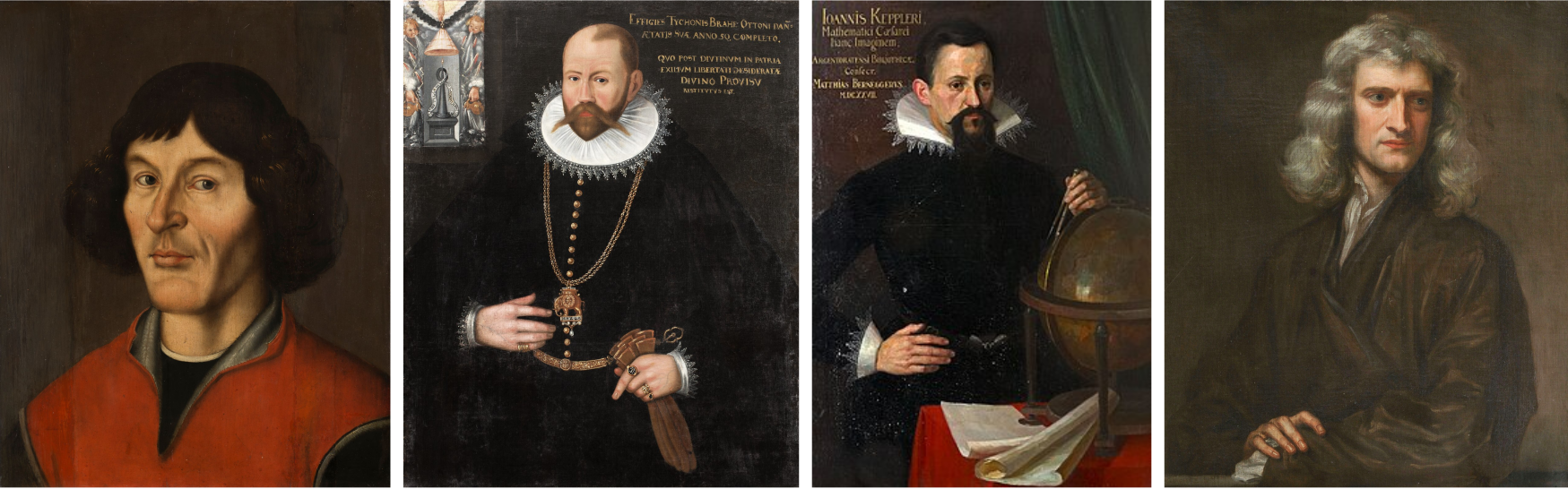
In 1600, Brahe hired the young German mathematician Johannes Kepler as his assistant. After his death, Kepler inherited all of Brahe’s data. He then spent the next decade trying to fit mathematical curves to Mars’s orbit. He tried over 70 different hypotheses before he finally discovered the crucial pattern. In 1609, Kepler published his first two laws of planetary motion, which, although not specifically required for A level, are worth describing briefly.
Until the work of Nicolaus Copernicus (1473–1543), it was widely believed that the Earth was at the centre of the universe, and the Sun, planets, and stars orbited around it in perfect circles. Unfortunately, the observations of planetary motion made this model very difficult to explain. Early astronomers tried to “fudge” these observations into the geocentric model by adding epicycles, or loops, on top of the orbits — it all became very complicated! Copernicus suggested instead that the Sun was at the centre of the universe — the heliocentric model — under which planetary motion became far simpler, although it still did not perfectly fit the observations, and some smaller epicycles still had to be added.
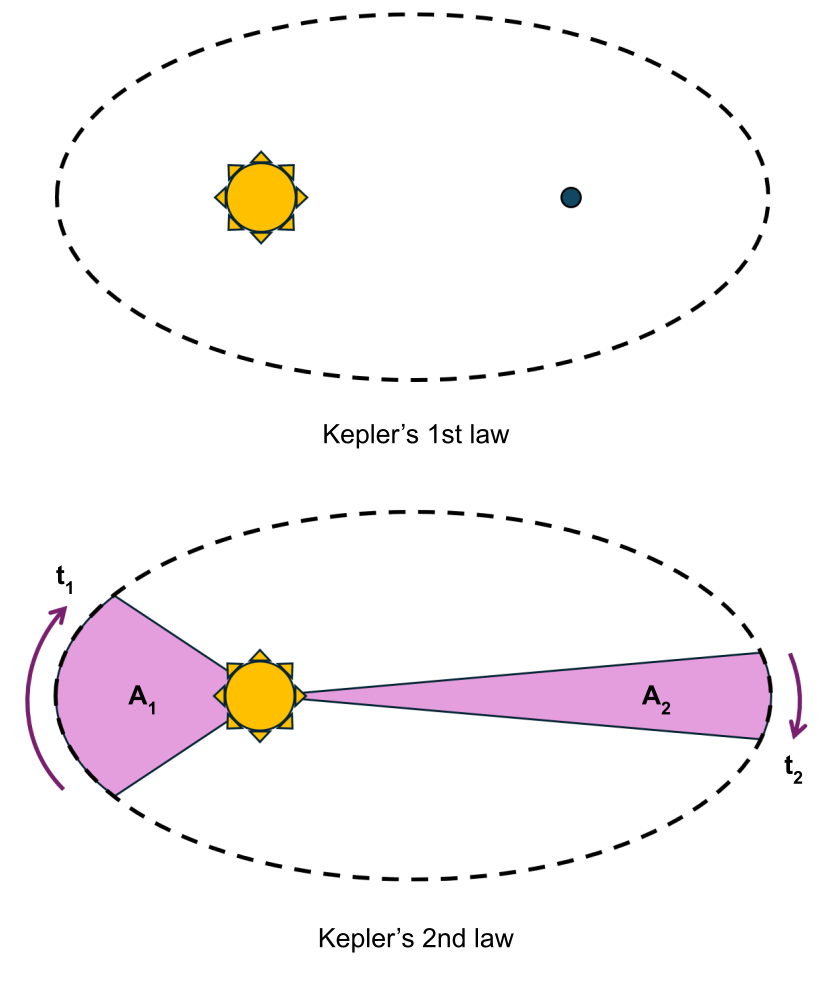
The difference Kepler made was that he advanced the heliocentric model and, based on Brahe’s data, suggested that planets orbit not in circular paths but in elliptical ones, with the Sun at one focus of the ellipse. This is known as Kepler’s 1st law. Kepler also observed that planets appeared to speed up as they approached the part of their orbit closest to the Sun, and slowed down at the opposite side. Kepler’s 2nd law describes this relationship by stating that planets sweep out equal areas of their elliptical orbit in equal times.
Kepler’s 3rd law took him another 10 years to figure out. He found that the orbital period of each planet was related to its distance from the Sun. This would have been harder than we might imagine to extract from the data, as not only did all of the multiplication have to be done laboriously by hand, but no one working at the time knew any of the distances to the planets, or any extra-terrestrial distances, and it was not until the 18th century that the distance to Venus could be determined. Kepler’s exact relationship stated that $T^2 \propto r^3$. Kepler called this the ‘harmony of the spheres’. Crucially, however, he had no idea why it worked — Kepler had no concept of gravity as a force. He thought the Sun had a kind of ‘animating soul’ that pushed the planets.
Newton’s work on gravity in 1687 was the final piece of the puzzle. Using his work on motion and gravity, he was able to derive Kepler’s laws and explain them using the concept of gravity, and when the distance to Venus was finally determined, all of the other distances in the Solar System could then be calculated. We can follow that derivation using what we have learnt so far:
Worth remembering
You may be expected to show stages of this derivation in an exam, so make sure you know why each stage is important.
$$\frac{GMm}{r^2} = m\omega^2r$$ The satellite’s mass $m$ cancels from both sides, leaving: $$\frac{GM}{r^2} = \omega^2r$$ Rearranging: $$GM = \omega^2 r^3$$
We know from the Periodic Motion topic that $\omega = \frac{2\pi}{T}$, so:
$$ \begin{aligned} GM &= \left(\frac{2 \pi}{T} \right) ^2 r^3 \\ GM &= \frac{4 \pi^2}{T^2} r^3 \\ \left(\frac{GM}{4 \pi^2}\right)T^2 &= r^3 \end{aligned} $$
For planets, where we take $M$ to be the Sun’s mass, $\left(\frac{GM}{4 \pi^2}\right)$ is a constant, so we can re-state the above as:
$$ \begin{aligned} \left(k\right)T^2 &= r^3 \\ T^2 &\propto r^3 \end{aligned} $$
Worth remembering
The relationship $T^2 \propto r^3$ holds for any gravitational system, not just planets orbiting the Sun.
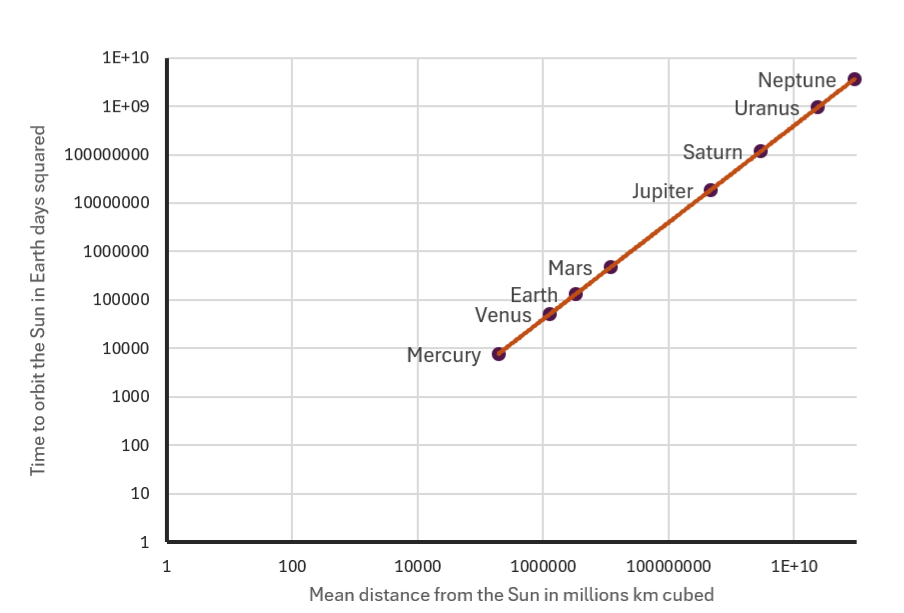
We can see this relationship clearly if we look at a graph of $T^2$ against $r^3$ for the planets in the Solar System, which shows a clearly linear relationship. This graph uses a logarithmic scale for both axes, otherwise the first six planets would be squeezed into a tiny space near the origin of the graph. It would still, however, be a straight line.
Synchronous and geostationary orbits
We have discussed low Earth orbits, which have an altitude of between 160 km and 2000 km. As we have just seen, as altitude $r$ increases, the period $T$ also increases, starting from a minimum of:
$$ \begin{gather} \left(\frac{GM}{4 \pi^2}\right)T^2 = r^3 \rightarrow T=\sqrt{\frac{4\pi^2r^3}{GM}}\\ T=\sqrt{\frac{4\pi^2\times ((6370+160)\times 10^3)^3}{6.67\times10^{-11}\times6.0\times10^{24}}}=5.2\times10^3\units{s}\\ \text{or } 87\text{ minutes} \end{gather} $$
We can use the $T^2 \propto r^3$ relationship to calculate the longest orbital time for a low Earth orbit:
$$ \begin{gather} \frac{6370+2000}{6370+160}=1.28 \\ \text{so }r_2=1.28 r_1 \end{gather} $$ Applying the relationship from Kepler’s third law:
$$ \begin{aligned} \frac{{T_1}^2}{{T_2}^2} &= \frac{{r_1}^3}{{r_2}^3} \\ \\ \frac{{(87\text{ minutes}})^2}{{T_2}^2} &= \frac{{r_1}^3}{({1.28r_1})^3} \\ \\ {T_2}^2 &= {(87\text{ minutes}})^2 \times 1.28^3 \\ \\ {T_2}^2 &\approx 15873 \\ \\ T_2 &= \sqrt{15873}\approx126 \text{ minutes} \end{aligned} $$
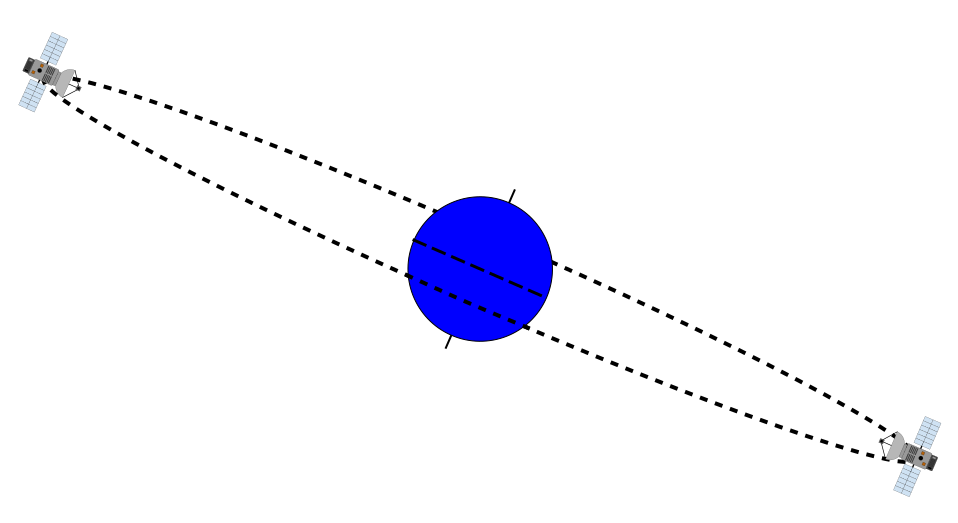
Clearly, as the radius increases, the time period also increases. Eventually, the time period will increase to equal 24 hours. At this radius, a satellite will take one whole day to make one orbit around the Earth, so it will have the same angular speed as the Earth. If a satellite is placed at this distance from the Earth, and above the equator, it will appear to remain in the same place relative to the Earth. This is called a geostationary orbit. Satellites can also be placed at this same distance but not directly above the equator; this is called a geosynchronous orbit.
Common exam mistake
It is easy to muddle geostationary and geosynchronous orbits, since both have the same 24-hour period. The distinction is the plane of the orbit: a geostationary orbit must be directly above the equator, so the satellite stays above a single fixed point on the Earth’s surface. A geosynchronous orbit shares the same period, but at any other inclination — so although it returns to the same point in the sky once a day, it does not stay fixed above one location.
Geostationary orbits can be very useful, as the relative position of the satellite and an observer on the Earth will not change. They are used for satellite TV, for example, as the satellite dish can be pointed at the satellite and never needs to move.
Calculating the radius of a geostationary orbit
We can work out the radius of the satellite’s orbit, as we know that its time period $T$ is $24\times60\times60=86400\units{s}$:
$$ \begin{aligned}r^3 &=\left(\frac{GM}{4 \pi^2}\right)T^2\\ r^3 &=\left(\frac{6.67\times10^{-11}\times 6.0\times10^{24}}{4 \pi^2}\right)86400^2 \\ r^3 &\approx 7.567\times10^{22} \\ \\ r &= \sqrt[3]{7.567\times10^{22}} \approx 4.23\times10^7\units{m} \end{aligned} $$
This is the only radius that will produce a geostationary or geosynchronous orbit — any closer, and the orbital period is too short; any further out, and it is too long.
Worked example
- An astronaut is orbiting the Earth inside a space station. Explain why the astronaut experiences a sensation of weightlessness.
- A research station orbits at an altitude of $650\units{km}$ above the Earth’s surface. Show that its orbital speed is approximately $7550\units{m s^{-1}}$.
- i) State and explain two features of a geostationary orbit.
The astronaut and the space station are both in free-fall around the Earth, travelling at the same orbital speed and experiencing the same centripetal acceleration. Since there is no relative motion between the astronaut and the station, there is no normal contact force between them — and it is the absence of this contact force, not the absence of gravity, that we perceive as weightlessness.
Equating the centripetal force with the gravitational force: $$\frac{mv^2}{r}=\frac{GMm}{r^2} \rightarrow v=\sqrt{\frac{GM}{r}}$$
The orbital radius is measured from the centre of the Earth, so $r=6370+650=7020\units{km}=7.020\times10^{6}\units{m}$: $$v=\sqrt{\frac{6.67\times10^{-11}\times6.0\times10^{24}}{7.020\times10^{6}}}$$ $$v\approx7550\units{m s^{-1}}$$
A geostationary orbit lies in the plane of the equator, so the satellite remains above the same point on the Earth’s surface. It also has a period of exactly 24 hours, matching the Earth’s own rotational period — this is what allows the satellite to stay above a fixed point, since it completes one orbit in exactly the time the Earth takes to complete one rotation.
ii) The research station’s engines are fired briefly, increasing its speed while its orbit remains approximately circular. Describe and explain what eventually happens to its orbital radius, orbital speed, and orbital period.
Immediately after the engines fire, the station’s speed is higher than the value needed to maintain its original orbit, so the centripetal force provided by gravity is momentarily too small to hold it in that orbit; the station moves outward into a higher orbit. Once it settles into this new, larger-radius orbit, its speed must satisfy $v=\sqrt{GM/r}$ for the new, larger $r$ — since $v$ is inversely proportional to $\sqrt{r}$, the station’s new stable orbital speed is actually lower than its original speed, despite the initial boost. Because $T^2\propto r^3$, the larger radius also means a longer orbital period than before.
Test yourself
Try the questions below to check your understanding of this topic. Numerical questions use different numbers each time, so you can attempt them more than once.