
3.7.2.1 + 3.7.2.2 Gravitational fields
3.7.2.1 Newton’s law
Gravity as a universal attractive force acting between all matter.
Magnitude of force between point masses: F = Gm1m2/r2, where G is the gravitational constant.
3.7.2.2 Gravitational field strength
Representation of a gravitational field by gravitational field lines.
g as force per unit mass, defined by g = F/m.
Magnitude of g in a radial field given by g = GM/r2.
Newton’s law of gravitation
Imagine an astronaut on board the ISS, orbiting $400 \units{km}$ above the surface of the Earth — are they still experiencing the Earth’s gravitational pull? What about the Moon, at $384,000 \units{km}$ away? How far does the Earth’s gravitational influence actually extend? If we look further afield still, we can see gravity influencing whole galaxies, acting across distances of millions of light years.
The force of gravity actually has an infinite range — although its strength decreases rapidly with distance, it never quite reaches zero. Imagine a lightbulb shining in a dark room: as light spreads out from the bulb, it is spread over increasingly large spheres as it travels. Since the surface area of a sphere is $A=4\pi r^{2}$, doubling the distance travelled quadruples the area the light is spread across, so the intensity of the light falls by the same factor of four. As we can see in the field diagrams in Figure 1, gravity spreads out in exactly the same way, following the same inverse square law as light.
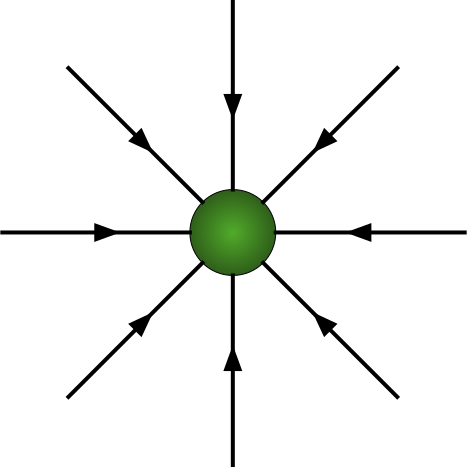
We can describe the inverse square law as applied to gravity as: $$F \propto \frac{1}{r^{2}}$$ It is important that you understand how the strength of the gravitational force changes with distance in terms of this relationship, as well as being able to calculate using the equations below. (You will meet this again in the Nuclear and Astrophysics topics)
Gravity is considered a universal force because every particle of matter in the universe attracts every other particle with a force acting along the line joining them, so every object with mass is affected by gravity, and the greater the mass of the object, the greater the strength of the gravitational field around it. The gravitational force is proportional to the mass of the object, $F \propto m$. This is of course an application of Newton’s second law. Gravity also always acts between two masses, so when calculating the force we need to know the mass of both objects.
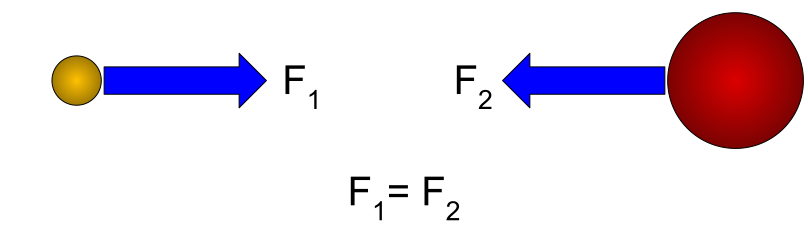
Putting all of these ideas together, we arrive at what we call Newton’s universal law of gravitation: $$F= \frac{G m_{1}m_{2}}{r^{2}}$$
This is the main equation that defines everything we will learn about gravity, so it is worth thinking about it carefully. Where:
- $F$ is the force between the two masses in $\units{N}$
- $G$ is the universal gravitational constant, which has a value of $6.67 \times 10^{-11} \units{N m^{2} kg^{-2}}$
- $m_{1}$ is the mass of the first object in $\units{kg}$
- $m_{2}$ is the mass of the second object in $\units{kg}$
- $r$ is the distance between the centres of the two objects in $\units{m}$
For example, the gravitational force between the Earth ($m_{1}=6 \times 10^{24} \units{kg}$) and the Moon ($m_{2}=7.3 \times 10^{22} \units{kg}$) can be calculated if we know the distance between them is $3.84 \times 10^{8}\units{m}$: $$F=\frac{G\times 6 \times 10^{24} \times 7.3 \times 10^{22}}{(3.84 \times 10^{8})^{2}}$$ $$F \approx2\times10^{20} \units{N}$$
Common exam mistake
Students often forget that it’s $r$ squared in the denominator, and end up with a gravitational force that’s far too large. Do a reality check on your answer — does the size of the number seem sensible for the scenario described?
The gravitational constant, G
The force described by this equation exists between any two masses — you and your chair, or you and your phone, two cars parked next to each other — but because $G$ is so small ($6.67 \times 10^{-11} \units{N m^{2} kg^{-2}}$), the force is negligible unless the mass of at least one of the objects is huge, such as the mass of a whole moon or a planet.
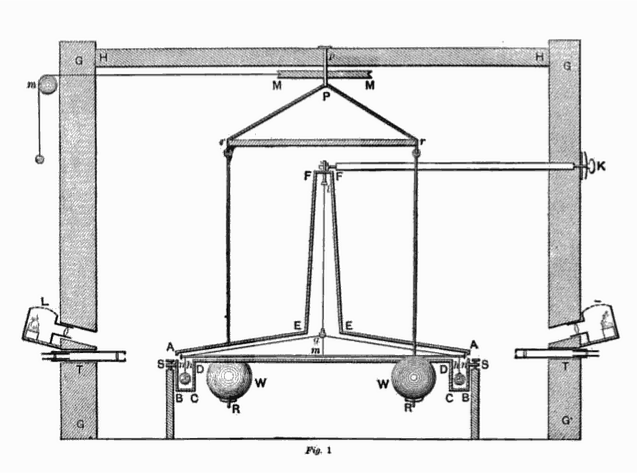
The value of $G$ was first determined by Henry Cavendish in 1798, using an apparatus called a torsion balance. Two small lead spheres were fixed to the ends of a light horizontal rod, which was suspended from its centre by a very fine wire. Two much larger lead spheres were then brought close to the small ones: the gravitational attraction between each pair caused the rod to rotate very slightly, twisting the suspension wire. By measuring the tiny angle of this twist, and knowing how much force was needed to produce that twist, Cavendish was able to calculate the size of the gravitational force between the spheres — and from that, the value of $G$ itself. The experiment is sometimes nicknamed “weighing the Earth,” since knowing $G$ allowed the mass of the Earth to be calculated for the first time, using the already-known values of $g$ and the Earth’s radius.
Gravitational field strength, g
Although all masses create a gravitational field, we are often only concerned with a smaller test mass placed within the field of a much larger source mass. From Newton’s law, a more massive test object experiences a larger gravitational force acting on it. But $F=mg$ tells us that producing a given acceleration in a more massive object also requires a larger force. These two effects cancel out exactly, so at any particular point in a gravitational field — such as at the surface of the Earth — the ratio $\frac{F}{m}=g$ is the same for every mass placed there. The value of $g$ is a property of the location within the field; it does not change when you place different masses there. We describe $g$ as the force per unit mass at a point. At the surface of the Earth, $g=9.81 \units{N kg^{-1}}$, meaning that every kilogram placed there feels a force of $9.81 \units{N}$, so a 70 kg person feels a force of 686 N, which is their weight.
Worth remembering
Because $g$ does not depend on the mass of the object placed in the field, every object at the same point in a gravitational field experiences the same acceleration, regardless of its own mass. This is why, famously, a feather and a hammer dropped together on the Moon — where there is no air resistance to complicate things — hit the ground at exactly the same time.
g in a radial field
However, $g$ is not invariant — it does change depending on the position of the object within the field. Just as the force of gravity decreases as the field lines spread out, $g$ also decreases with distance from the source mass. We can link $g$ with distance by starting with the definition of $g$, force per unit mass: $$g=\frac{F}{m} \rightarrow F=mg$$ and substituting this into Newton’s law of gravitation: $$mg=\frac{G m_{1}m_{2}}{r^{2}}$$ If $m_{1}$ is the source mass and $m_{2}$ is the test mass, we can cancel the test mass $m_{2}$ from both sides, which gives us this equation for gravitational field strength: $$g=\frac{GM}{r^{2}}$$ where $M$ is the mass in $\units{kg}$ of the source mass. This means we can describe the gravitational field of any mass $M$ completely using $g = GM/r^{2}$ — we never need to know what test mass will later be placed there. A key consequence of this is that all objects at the same location in a gravitational field experience the same acceleration, regardless of their mass, which is why a feather and a hammer fall together in a vacuum.
Some key points to understand are:
- If an object is placed on a planet with half the mass of the Earth, but the same diameter, the value of $g$ will be half that of Earth.
- If an object on Earth is moved to twice its original distance from the centre, the gravitational field strength will decrease to a quarter of its original value.
Common exam mistake
Because $g \propto 1/r^{2}$, doubling the distance from a source mass does not halve $g$ — it quarters it. Students often apply the inverse relationship instead of the inverse-square relationship, particularly under exam pressure. Always check whether a question is asking you to double, triple, or otherwise scale the distance, and square that scale factor before dividing.
As you move further from a source mass the gravitational field strength decreases, so the force acting on a test mass also decreases. If there are two source masses, such as two planets with similar masses, as the test object moves away from one and towards the other, the force from the second object will increase. If the two source masses are equal, the test mass will experience no net force at the midpoint, as in Figure 4.
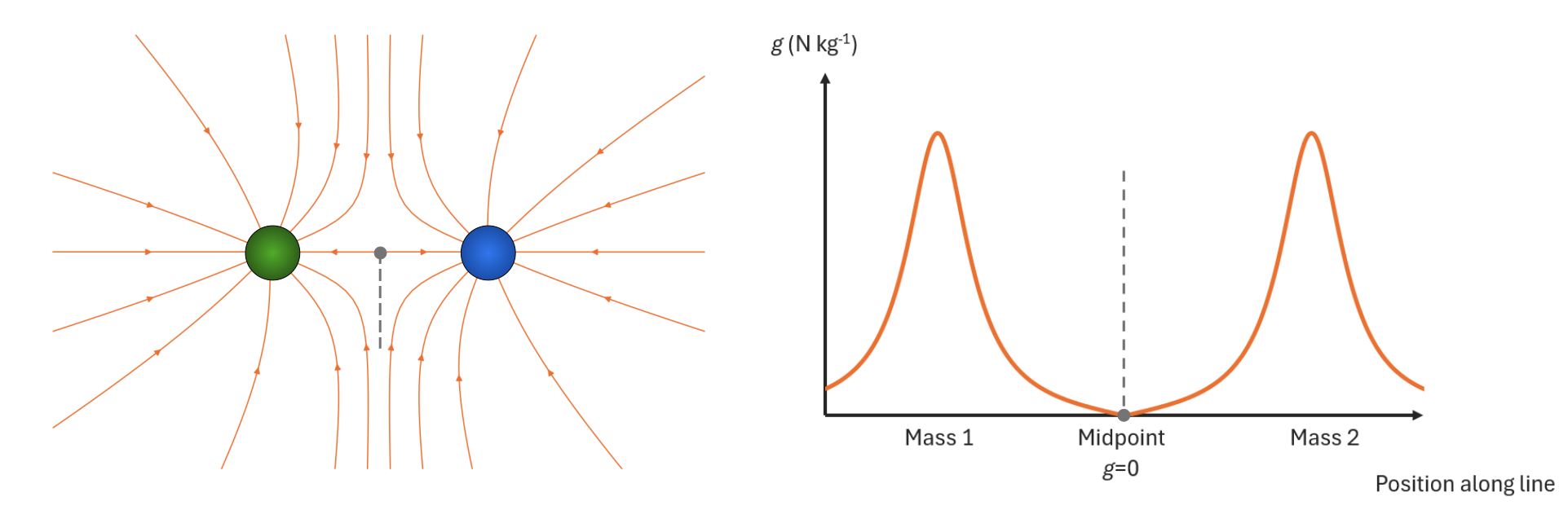
If the two source masses are different in mass, this point of no net force can still be calculated. For example, an object with mass $m$ placed between the Earth and the Moon would experience no force at the point where its distance from Earth ($x$) and its distance from the Moon ($y$) satisfy: $$\frac{G M_{E}}{x^{2}}=\frac{G M_{M}}{y^{2}}$$ The constant $G$ cancels, leaving us with: $$\frac{M_{E}}{M_{M}}=\frac{x^{2}}{y^{2}} \rightarrow \frac{x}{y}=\sqrt{\frac{M_{E}}{M_{M}}}$$ This allows us to calculate the ratio of the distances from the Earth and the Moon. The mass of the Earth is $6.0\times 10^{24}\units{kg}$ and the mass of the Moon is $7.4\times 10^{22}\units{kg}$: $$\sqrt{\frac{6.0\times 10^{24}}{7.4\times 10^{22}}}=9.0$$ So the distance the test mass needs to be from Earth ($x$) is 9 times the distance to the Moon ($y$), meaning $x$ makes up $\frac{9}{10}$ of the total Earth–Moon distance: $$x=3.84\times 10^{8} \units{m} \times 0.9 = 3.5\times 10^{8} \units{m}$$
Radial vs uniform fields
Despite $g$ decreasing with distance, we normally do not observe any change in its value close to the surface of a planet. This is because, relative to the size of the planet, the divergence in the field lines over the small heights we are concerned with is almost negligible, so the field appears uniform close to the surface.
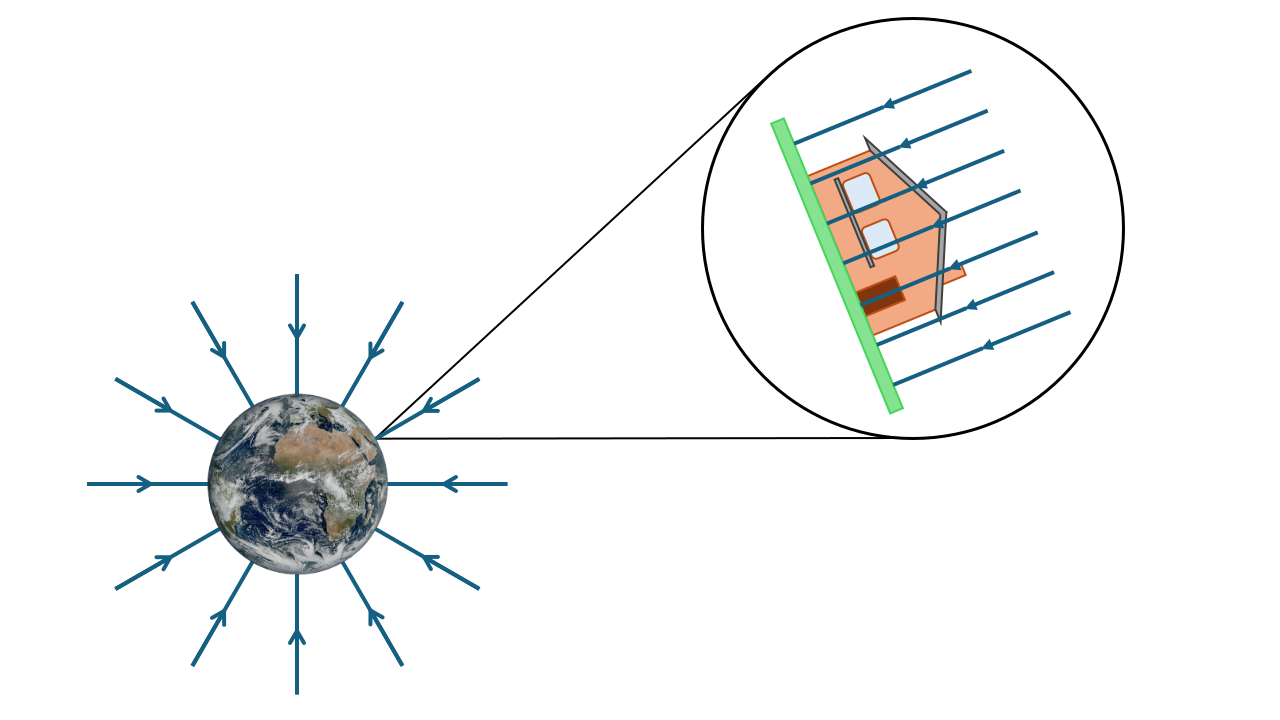
Even for astronauts on the ISS, the gravitational field strength is not much smaller than at the surface. The ISS orbits $400 \units{km}$ above the surface of the Earth, so its value of $r$ is $6370 \units{km}+400 \units{km}=6770 \units{km}$, giving: $$g=\frac{G\times6.0\times 10^{24}}{(6770\times10^{3})^{2}}=8.7 \units{N kg^{-1}}$$
Common exam mistake
It is tempting to treat $g=9.81 \units{N kg^{-1}}$ as a fixed constant that applies everywhere near the Earth — but it is only an approximation valid close to the surface. As the ISS calculation above shows, even a few hundred kilometres of altitude is enough to measurably reduce $g$. For any question involving significant altitude — a satellite, a high-flying rocket, or another planet entirely — you must use $g=GM/r^{2}$ with the correct value of $r$, not the surface value of 9.81 N kg⁻¹.
Field line diagrams
We introduced field line diagrams back in the What is a Field? topic, but it is worth recapping the key rules specifically as they apply to gravity, since sketching and interpreting these diagrams accurately is a common exam skill.
- Direction: Arrows always point towards the source mass, since gravity is always attractive; the lines converge inward.
- Spacing: Lines closer together represent a stronger field. Equal spacing represents a uniform field, such as close to the Earth’s surface on a small scale.
- No crossing: Field lines never cross, since at any point in space there is exactly one field direction.
- Radial symmetry: For a spherical mass, lines radiate inward symmetrically, like the spokes of a wheel pointing towards the hub.
- Starting point: Lines terminate at the mass. For an isolated mass, they extend outward to infinity in the reverse direction, becoming further and further apart, but never actually reaching zero strength.
Worked example
- A newly discovered rocky exoplanet has a uniform density of $4.00\times 10^{3}\units{kg m^{-3}}$. The gravitational field strength at its surface is measured to be $6.60 \units{N kg^{-1}}$. Show that the gravitational field strength at the surface of a uniform sphere, $g_{s}$, is related to its density $\rho$ and radius $R$ by:
- Calculate the radius of the exoplanet, giving your answer to an appropriate number of significant figures.
$$g_{s}=\frac{4}{3}\pi G \rho R$$
Starting from $g=GM/r^{2}$ applied at the surface, where $r=R$: $$g_{s}=\frac{GM}{R^{2}}$$
Recall from the Materials topic that density is defined as $\rho=\frac{m}{V}$, so the mass of a uniform sphere is $M=\rho V=\frac{4}{3}\pi R^{3}\rho$. Substituting this in for $M$: $$g_{s}=\frac{G\times\frac{4}{3}\pi R^{3}\rho}{R^{2}}$$
Cancelling $R^{2}$ leaves us with: $$g_{s}=\frac{4}{3}\pi G \rho R$$
Rearranging for $R$: $$R=\frac{3g_{s}}{4\pi G \rho}$$
Substituting in the values given: $$R=\frac{3\times6.60}{4\pi\times6.67\times10^{-11}\times4.00\times10^{3}}$$ $$R \approx 5.91\times10^{6} \units{m}$$
Since the density and $g_{s}$ were both given to three significant figures, it is appropriate to give the radius to three significant figures too.
Test yourself
Try the questions below to check your understanding of this topic. Numerical questions use different numbers each time, so you can attempt them more than once.