
3.6.1.2 Simple harmonic motion
Analysis of characteristics of simple harmonic motion (SHM).
Condition for SHM: $a\propto -x$
Defining equation: $a=-\omega^{2}x$
$x=A\cos\omega t$ and $v=\pm \omega \sqrt{\left (A ^{2}-x^{2} \right )}$
Graphical representations linking the variations of x, v and a with time.
Appreciation that the v - t graph is derived from the gradient of the x - t graph and that the a - t graph is derived from the gradient of the v - t graph.
Maximum speed $=\omega A$
Maximum acceleration $=\omega^{2}A$
This part of the module builds on what has already been learnt in circular motion, specifically how the terms used in circular motion can be applied to SHM.
Oscillations are common in many aspects of everyday life, the suspension in a car as it rides over a bump, the processors in computers oscillate at very high frequencies 2 GHz, musical instruments oscillate, stars and planet orbits are all examples of oscillation.
When an object which could oscillate is stationary it is said to be in equilibrium, when it begins to oscillate its displacement from equilibrium changes constantly.
The displacement increases as it moves away from the equilibrium position till it reaches a maximum. It then decreases as it moves back towards the equilibrium position.
Once the equilibrium position is reached it reverses and begins to increase again until another -equal but opposite- maximum is reached.
Finally it decreases until the equilibrium position is reached again.
Definitions of key terms for Oscillations
- Amplitude (A) – The maximum displacement from the equilibrium ($\units{m}$)
- Period (T) – The time for one complete cycle of oscillation ($\units{s}$)
- Frequency (f) – The number of complete oscillations per second ($\units{Hz}$)
Common exam mistake
Amplitude is measured from the equilibrium position to the maximum displacement — not the full distance from one extreme to the other. Reading the peak-to-peak distance straight off a displacement–time graph and calling that "the amplitude" is a very common error; that distance is actually $2A$.
Phase - phase is the measure of the position of an oscillator within its cycle. One whole cycle is 2π radians, so if one wave peak meets the trough of another they are π radians out of phase. If one peak meets the peak of the next wave they are 2π radians out of phase, but this is the same as being in phase, so the oscillation of a wave repeats when the phase changes by any multiple of 2π.
The phase difference between two objects oscillating at the same frequency is given by,
Common exam mistake
Phase difference calculated this way comes out in radians, matching $\omega$'s units. If a question asks for the answer in degrees, you'll need to convert at the end — don't mix degrees into the calculation itself, and don't forget the conversion if degrees are specifically requested.
Simple Harmonic Motion
Lots of things oscillate…
...But not all of them are simple harmonic motion.
Free Oscillations are when the amplitude of the oscillation remains constant and there are no frictional forces.
All harmonic oscillators have the following properties,
- The period of oscillation in independent of amplitude. Which means that each oscillation takes the same time.
- A force is acting on the oscillating object to return it to its equilibrium position.
- Inertia makes the system overshoot the equilibrium position when it is in motion.
In class you will carry out a series of practicals in which you will explore the relationship between, mass, amplitude, and length of a pendulum with time period. You will be expected to to draw graphs using logarithms. To find out about logs and how they are a powerful tool in investigations click here
Properties of simple harmonic oscillators
Simple Harmonic Oscillators all have the following features:
- The acceleration is directed towards a fixed point in its path (the equilibrium position)
- The acceleration is in the opposite direction to the displacement
- and is directly proportional to its distance from that fixed point
If these three conditions are met the the body is moving with simple harmonic motion. In practice, this looks like:
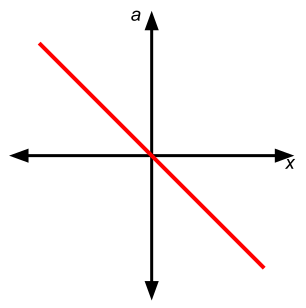
You can see that whenever the displacement is positive, the acceleration is negative. The relationship is still directly proportional.
Common exam mistake
Don't drop the minus sign in $a=-\omega^{2}x$. It's not just decoration — it's what makes the acceleration a restoring force, always pointing back towards equilibrium and opposite to the displacement. Leaving it out (or losing it partway through a calculation) gives an acceleration that points the wrong way.
If we compared how the displacement, velocity and acceleration of a simple harmonic oscillator varies with time. When the displacement is at its maximum, the velocity is zero, and the acceleration is at its maximum value, in the other direction.
When the displacement is zero (when the oscillator passes through the equilibrium position) the velocity is at its maximum and the acceleration is zero.
Common exam mistake
This is the single most commonly mixed-up fact in SHM: velocity is maximum at the equilibrium position (zero displacement) and zero at maximum displacement — the opposite way round to what feels intuitive. Acceleration works the other way: zero at equilibrium, maximum at the extremes. Double check which quantity a question is asking about before answering.
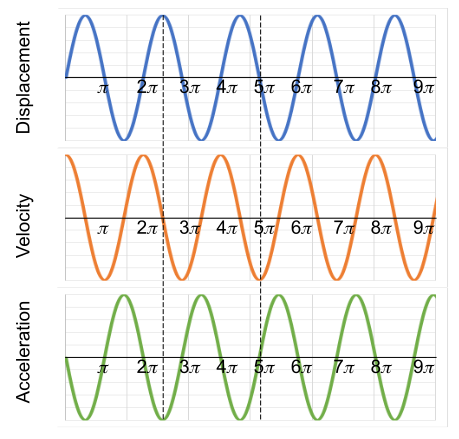
We can use these basic principles to derive the equations for SHM.
There are several links between SHM and circular motion. Clearly they are both periodic in nature, but there are other clear similarities as summarised below:
| Circular motion | Simple Harmonic Motion |
|---|---|
| Radius (r) | Amplitude (A) |
| Angular displacement (θ) | Phase (ωt) |
| Angular velocity (ω) | Angular frequency (ω) |
The diagram below shows a particle spinning in a circle and another moving with SHM. When the angle $\theta=0$ the displacement $x$ will be equal to the radius $r$. At this point the displacement will also equal the amplitude of the oscillator.
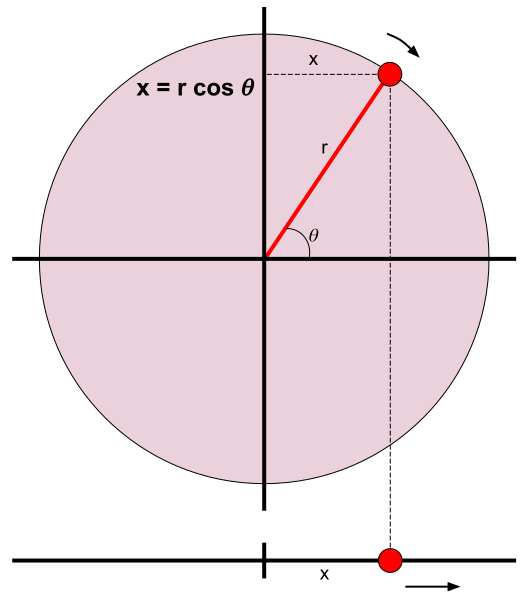
As the amplitude equals the radius, $A=r$. and so the displacement at any angle θ can be described as:
The angular displacement $\theta$ at time $t$ is $\omega t$ or $2\pi ft$ which allows us to describe the displacement of the oscillator at any time:
The full set of equations that you need to know are:
Common exam mistake
Don't drop the $\pm$ in $v=\pm\omega\sqrt{A^{2}-x^{2}}$. At any given displacement (other than the extremes), the oscillator could be moving in either direction — the $\pm$ reflects that. If a question asks for a direction or expects two possible answers, giving only the positive root misses half the answer.
| acceleration | $$a=-\omega^{2}x$$ |
| displacement | $$x=A\cos\left ( \omega t \right )$$ |
| speed | $$v=\pm\omega\sqrt{\left ( A^{2}-x^{2} \right )}$$ |
| maximum speed | $$v_{max}=\omega A$$ |
| maximum acceleration | $$a_{max}=\omega^{2} A$$ |
Test yourself
Try the questions below to check your understanding of this topic. Numerical questions use different numbers each time, so you can attempt them more than once.