
3.4.1.5 Newton's laws of motion
Knowledge and application of the three laws of motion in appropriate situations.
$F = ma$ for situations where the mass is constant.
Newton's 1st Law
What keeps something moving once it's started? It's tempting to say a moving object has kinetic energy, so energy must be causing the motion, but where did that energy come from in the first place? Imagine throwing a ball: the force from your arm starts it moving, but that force disappears the instant it leaves your hand. If forces cause motion, shouldn't the ball stop moving as soon as the force does?
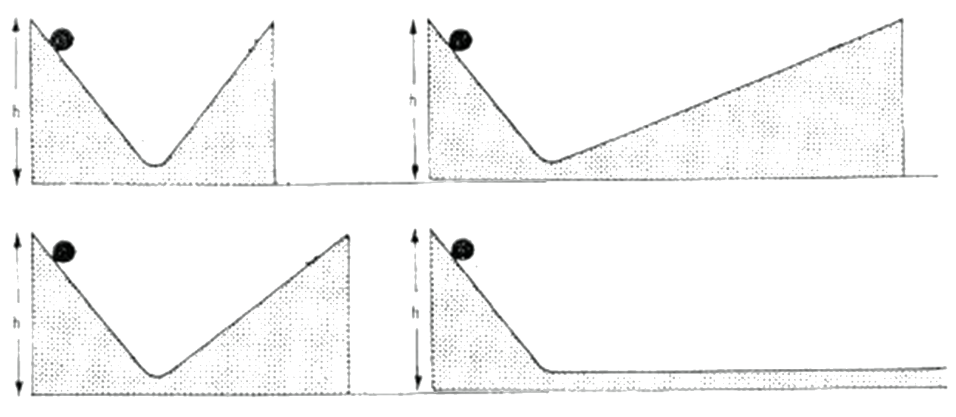
Galileo explored this with a thought experiment: imagine rolling a ball down a slope, with no friction anywhere. It always rises to roughly the same height on the far side, no matter how steep or shallow that far slope is. Make the far slope shallower, and the ball has to travel further to reach that height. Make it perfectly flat, and the ball never reaches that height at all; it just keeps rolling, forever, at a constant velocity.
This leads to the conclusion that forces are needed to change motion, not to sustain it; once a force has caused an object to start moving, it will carry on moving unless something acts to stop it. This is usually hard to notice in everyday life, since friction and air resistance are almost always present, quietly acting as that "something". This is the idea behind Newton's 1st law of motion:
Every body continues in its state of rest, or of uniform motion in a straight line, unless acted on by some external resultant force.
When an object moves at constant velocity, or is at rest, the forces acting on it must sum to zero. It's sometimes necessary to resolve these forces into horizontal and vertical components to check this, exactly as with the equilibrium problems met earlier in Statics; Newton's 1st law is really just an extension of that same idea of balanced forces, now applied to moving objects as well as stationary ones.
Common exam mistake
"Balanced forces" does not mean "no motion" — it means no change in motion. An object moving in a straight line at a constant speed has balanced forces acting on it, just as much as an object sitting still. Don't assume balanced forces implies an object must be at rest.
This law also defines what a force actually does: it causes acceleration. Because of this, the law is sometimes called the law of inertia, inertia being an object's reluctance to change its state of motion, whether that means starting to move, stopping, or changing direction. A body with a large mass needs a larger force to produce the same change in velocity as a body with a small mass, so an object's mass is really just a measure of its inertia.
Newton's 2nd Law
The 2nd law can be stated as:
The rate of change of momentum of a body is directly proportional to the resultant external force acting on it, and takes place in the direction of that force.
This defines the idea of a resultant force, the overall force left over once every other force acting on an object has been combined. When the resultant force on an object is not zero, it will accelerate. Looking at this mathematically, we can derive a familiar equation from the law above:
where $F$ is the resultant force, and $\frac{\mathrm{d} }{\mathrm{d} t}\left ( mv \right )$ is the rate of change of momentum. Turning this into an equation means introducing a constant of proportionality, $k$:
The unit of force is defined so that one unit accelerates a mass of one kilogram by one metre per second squared, which makes $k=1$ (and dimensionless, so it needs no units of its own). Considering only situations where the mass stays constant:
Since $\frac{\mathrm{d}v }{\mathrm{d} t}$ is acceleration, this gives the familiar equation for the second law:
It's worth remembering that $F$ here is always the resultant force, not any single force acting on the object; it's essential to identify every force acting on a body, often with a free-body diagram, before applying this equation.
Common exam mistake
The $F$ in $F=ma$ is always the resultant force, never a single individual force acting on the object. If several forces act on a body, they must be combined (added as vectors, accounting for direction) before this equation can be used. Substituting just one applied force, such as thrust or driving force alone, without accounting for opposing forces like friction or air resistance, is a very common source of error.
One of the most common applications of the second law is finding an object's weight, since weight is simply the resultant force due to gravity acting on a mass:
Newton's 3rd Law
You may know this law as "every action has an equal and opposite reaction", but that phrasing is easy to misunderstand. A more precise statement is:
If a body A exerts a force on a body B, then B exerts an equal and oppositely directed force on A.
Whenever one force exists, a second one arises alongside it. These are called Newton pairs, or action-reaction pairs, and they always act on two different bodies, never on the same one.
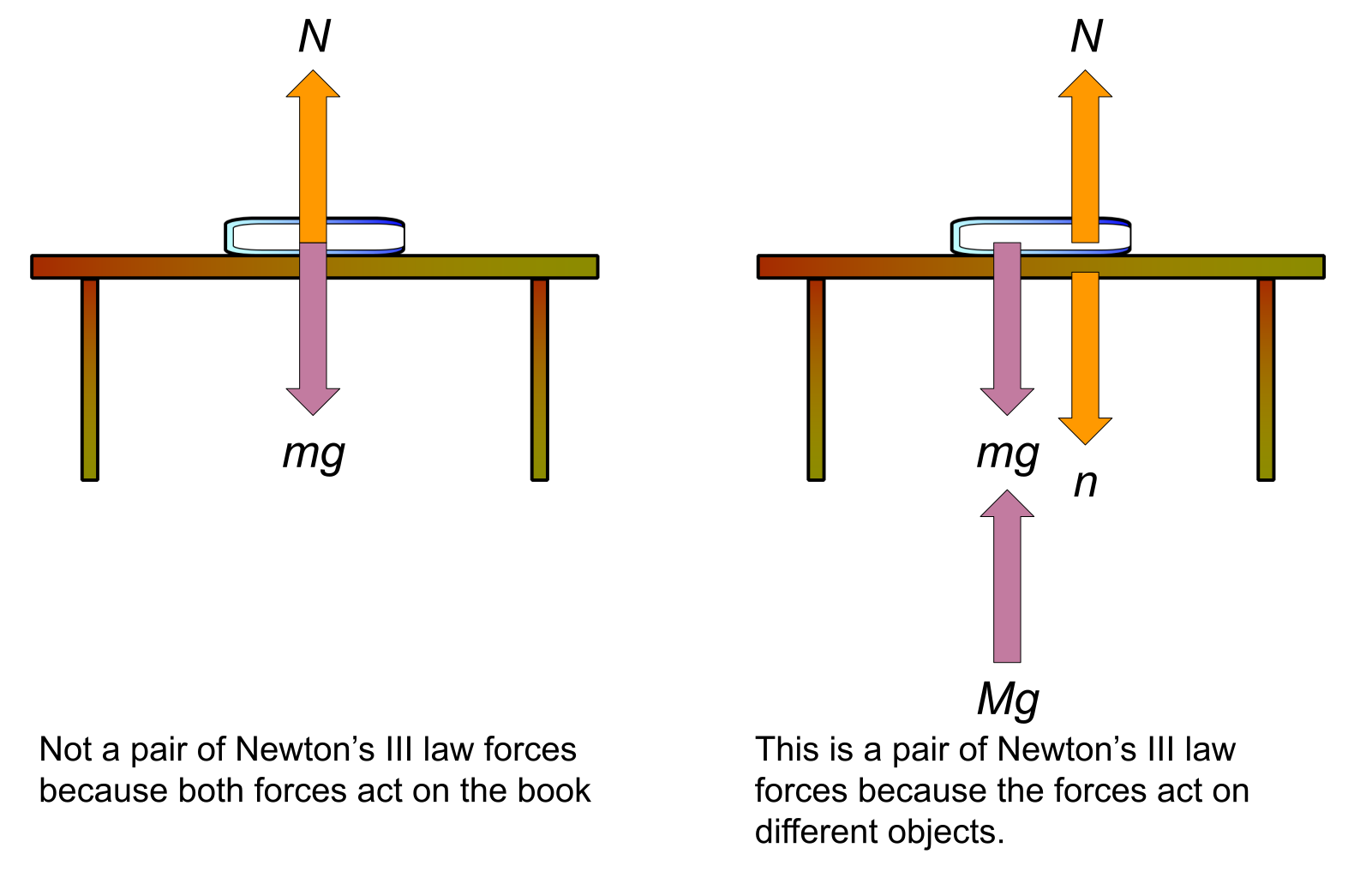
A common mistake is to assume that any two equal and opposite forces acting on the same object must be a Newton pair, such as an object's weight and the normal contact force supporting it. They aren't: both of those forces act on the same body, so they can't be a Newton pair, they simply happen to be balanced, as in Newton's 1st law. Use this checklist to identify genuine Newton pairs:
- They're equal in size, along the same line of action.
- They act on two different bodies, never the same one; otherwise, they'd simply cancel out and nothing would ever happen.
- They're always the same type of force. In the book-on-table example, both forces in the true pair are contact forces; weight, by contrast, is a gravitational force, so it can never be part of a Newton pair with a contact force.
Common exam mistake
An object's weight and the normal contact force supporting it are not a Newton pair, even though they're equal and opposite — both act on the same body (the book), so they're just balanced forces under Newton's 1st law. A genuine Newton pair must satisfy all three checklist points above: equal magnitude and same line of action, acting on different bodies, and the same type of force. Miss any one of these and it isn't a real Newton pair.
A useful test case is a person standing in a stationary lift, where the only forces acting on the person are their weight, $W$, and the contact force from the floor, $N$; here, $W=N$. If the lift accelerates, there must be a resultant force acting on the person, so $N$ and $W$ can no longer be equal, which confirms they were never a Newton pair to begin with, just two forces that happened to balance while the lift was still.
The three laws at a glance
| In short | Key idea | |
|---|---|---|
| 1st Law | An object's velocity won't change unless a resultant force acts on it. | Balanced forces → constant velocity (or rest) |
| 2nd Law | A resultant force causes an object to accelerate. | $F=ma$ |
| 3rd Law | Forces always come in equal, opposite, same-type pairs, acting on two different bodies. | Newton pairs never cancel, since they act on different objects |
Worked example
A car is designed to break the land speed record. At one instant of its motion, the thrust exerted on the car is 230 kN, and its mass at this instant is 11 000 kg.
- The acceleration of the car at this instant is 2.9 m s−2. Calculate the air resistance acting on the car.
- The thrust on the car remains constant as its speed increases. Explain why the acceleration decreases, and eventually reaches zero.
The resultant force is found first, using Newton's 2nd law:
The resultant force is the difference between the two horizontal forces acting on the car, the thrust driving it forward and the air resistance opposing it:
Air resistance increases as speed increases, so as the car speeds up, the resultant force (thrust minus air resistance) gets smaller, and by Newton's 2nd law, the acceleration decreases along with it. Eventually, the car reaches a speed at which air resistance exactly equals the thrust; at that point the resultant force is zero, so the acceleration is also zero, and the car has reached its maximum possible speed. This is exactly the same idea as the terminal velocity reached by a falling object once drag balances weight.
Common exam mistake
"Maximum speed" doesn't mean the driving force disappears or drops to zero — the thrust stays exactly the same throughout. What changes is the resultant force: as air resistance grows to match the constant thrust, the resultant (and therefore the acceleration) shrinks to zero, even though the car is still being driven forwards at full thrust. It's a common mistake to think a vehicle at its top speed must have "run out of force" somehow, rather than reaching a balance between two forces that are both still fully present.
Test yourself
Try the questions below to check your understanding of this topic. Numerical questions use different numbers each time, so you can attempt them more than once.