
3.7.2.4 Gravitational fields
Energy considerations for an orbiting satellite. Total energy of an orbiting satellite. Escape velocity. Use of satellites in low orbits and geostationary orbits.
Kinetic and potential energy of an orbiting satellite
We have already seen that a satellite moving in a circular orbit is simply falling continuously around the Earth, with gravity supplying exactly the centripetal force needed to keep it on its circular path, and from this we derived the orbital speed:
$$v=\sqrt{\frac{GM}{r}}$$
Because the satellite is moving, it has kinetic energy, and because it sits within the Earth’s gravitational field, it has gravitational potential energy too. Both of these can be written in terms of the orbital radius r alone, which turns out to be rather useful.
The kinetic energy is just the familiar $E_k=\frac{1}{2}mv^2$, and substituting in $v^2=\frac{GM}{r}$ gives:
$$E_k=\frac{GMm}{2r}$$
The gravitational potential energy, meanwhile, is the expression we met when discussing gravitational potential — remembering that potential energy is defined to be zero at infinity and negative everywhere else:
$$E_p=-\frac{GMm}{r}$$
It is worth pausing on how similar these two expressions are. They have the same $GMm/r$ term, but $E_k$ is positive and exactly half the size of $E_p$, while $E_p$ is negative. This isn’t a coincidence, and it falls straight out of the same force-balance condition that gave us the orbital speed in the first place.
The same method works for estimating the kinetic energy of any orbiting body, not just an artificial satellite — a planet going round the Sun, a moon going round a planet, or a spacecraft in orbit around Mars, provided we know its orbital radius and the mass of the object it’s orbiting.
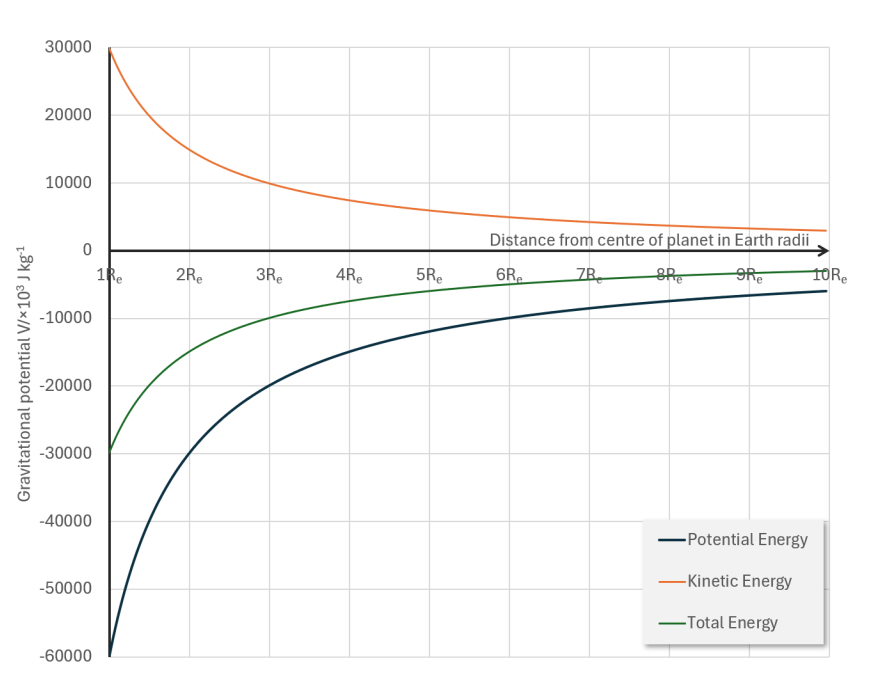
Total energy of an orbit (and why it's negative)
The total energy of an orbiting satellite is simply the sum of these two:
$$E_{total}=E_k+E_p=\frac{GMm}{2r}-\frac{GMm}{r}=-\frac{GMm}{2r}$$
So the total energy of any circular orbit is negative, and its size is exactly half the size of the gravitational potential energy at that radius — in fact it’s equal in size to the kinetic energy, just with the opposite sign. Of course, seeing a negative value for a total energy can look alarming the first time you meet it, but there’s nothing wrong with the physics: the negative sign is simply telling us that the satellite is bound to the Earth. It doesn’t have enough energy to coast off to infinity and stop there, which is exactly what we’d expect, since we know it’s happily orbiting rather than flying away.
Worth remembering
The size of a satellite’s total energy, $\frac{GMm}{2r}$, is often called its binding energy — it’s the amount of energy you’d need to give the satellite to raise its total energy from its current negative value up to zero, which is exactly the condition for it to just escape. We’ll come back to this in the worked example.
As the orbital radius r increases, the total energy becomes less negative, moving closer to zero. So a satellite in a higher orbit is less tightly bound than one in a lower orbit, even though — as we saw on the last page — it’s also moving more slowly. Raising a satellite’s orbit therefore requires energy to be added to the system, even though the satellite ends up with less kinetic energy once it gets there; the extra energy all goes into potential energy, and then some, since the total still has to increase. If a total energy ever becomes positive, the object is no longer in a bound orbit at all — it has enough energy to escape completely, which brings us to escape velocity.
Common exam mistake
It’s tempting to think a negative total energy means something has gone wrong in a calculation, especially when the kinetic energy on its own is clearly positive. Don’t change the sign to make the total look “more sensible” — a negative total energy is the correct, physical answer for any bound orbit, and it’s only when a calculated total energy comes out positive that you should sit up and take notice, because that’s telling you the object isn’t actually in orbit at all.
Escape velocity
Picture standing on a hilltop, as Newton did when he imagined firing a cannonball ever faster to see it curve around the Earth rather than fall back to the ground. Fire it fast enough, and rather than settling into an orbit at all, the cannonball would simply leave and never come back. This minimum speed — the speed at which an object has just enough kinetic energy to escape a gravitational field completely, reaching an infinite distance with (in the limit) zero speed left over — is called the escape velocity.
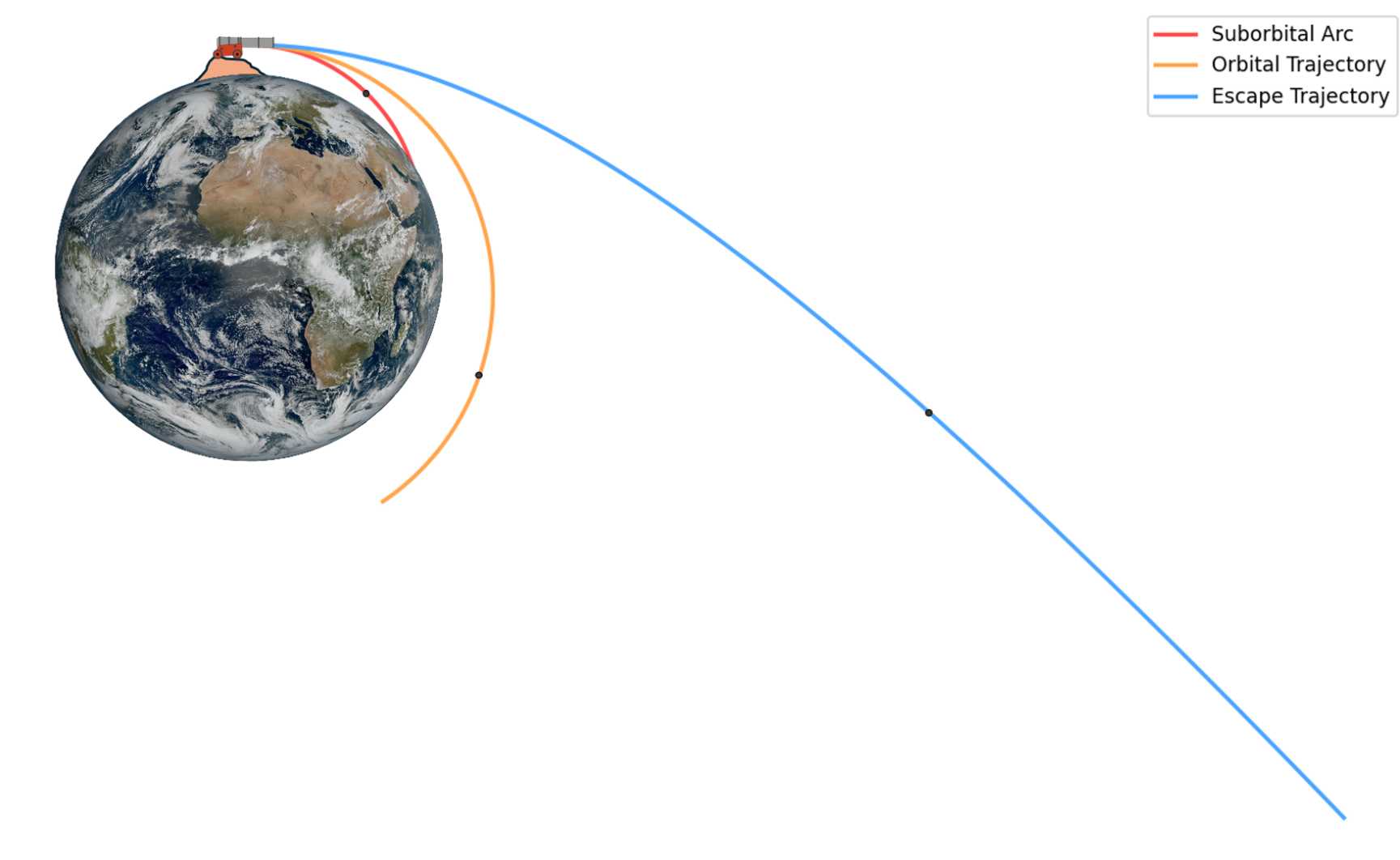
It is worth being clear about what escape velocity actually means, because it is a common source of confusion. It is not the speed needed to reach a particular orbit, and it doesn’t mean the object accelerates forever — the object is still decelerating the whole way out, since gravity is still acting on it and doing negative work as it goes. Escape velocity is simply the minimum launch speed for which that deceleration never quite brings the object to a halt before it reaches an infinite distance, after which gravity's pull becomes negligible.
Deriving the escape velocity formula
We can find escape velocity directly from the total energy expression above. The boundary between a bound orbit and an escaping object is exactly the boundary between negative and positive total energy, so the condition for “just escaping” is a total energy of precisely zero:
$$E_k+E_p=0$$
$$\frac{1}{2}mv_{esc}^2-\frac{GMm}{r}=0$$
The mass of the escaping object, m, cancels — which tells us straight away that escape velocity doesn’t depend on the mass of whatever is trying to escape, only on the mass of the body it’s escaping from and the distance r from that body’s centre. Rearranging for $v_{esc}$ gives:
$$v_{esc}=\sqrt{\frac{2GM}{r}}$$
Comparing this with the orbital speed formula from the last page, $v=\sqrt{GM/r}$, we can see that escape velocity is always exactly $\sqrt{2}$ times the speed of a circular orbit at the same radius — so to turn a circular orbit into an escape trajectory, you don’t need to double your speed, you only need to increase it by a factor of about 1.41.
Common exam mistake
The r in the escape velocity formula is measured from the centre of the body being escaped, not from its surface, and not the altitude of a launch site above sea level. For an object launched from the Earth’s surface, r is the Earth’s radius, roughly $6.37\times10^6\,\mathrm{m}$, not zero and not some smaller number representing “how far there is left to go.” Using the wrong distance is one of the most common ways marks are lost on this calculation.
Low Earth orbit vs geostationary orbit: choosing an orbit
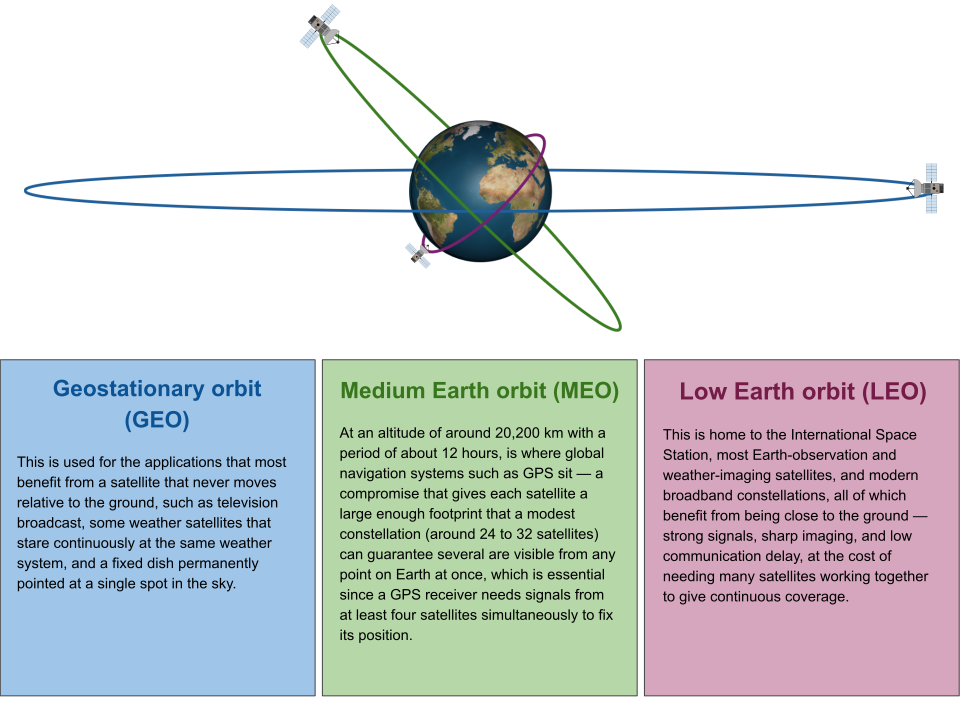
Not every satellite needs, or wants, to be in the same kind of orbit, and the energy ideas above go a long way towards explaining why. A low Earth orbit (LEO) typically sits at an altitude of a few hundred to around two thousand kilometres, orbiting once every ninety minutes or so, while a geostationary orbit (GEO) — whose radius we calculated on the last page from Kepler’s third law — sits at an altitude of nearly 36,000 km and takes a full 24 hours to complete one orbit, matching the Earth’s rotation exactly.
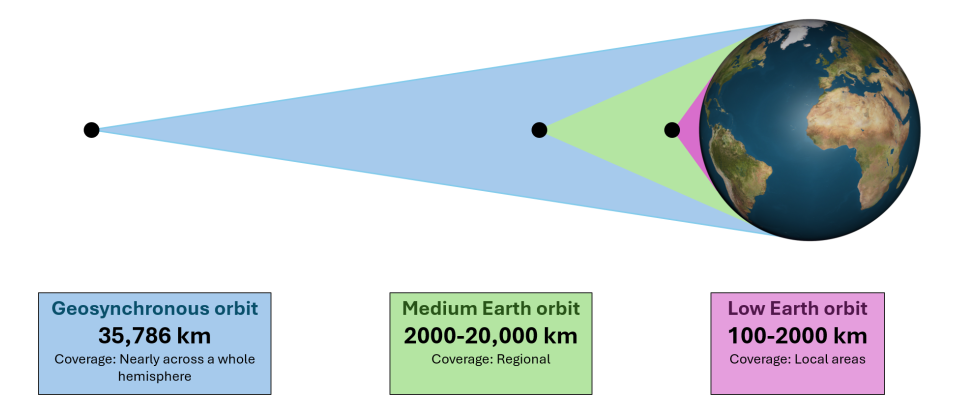
Getting a satellite into a low orbit costs far less energy than getting it all the way out to geostationary radius — both because there is simply less potential energy to climb, and because, as we saw in Section 2, a higher orbit means a less negative (higher) total energy overall. A low orbit also puts the satellite much closer to the ground, which matters enormously for anything that relies on the strength of a returning signal, such as imaging the Earth’s surface in detail or communicating with equipment that can’t transmit powerfully.
The trade-off is coverage. A satellite close to the Earth only has a small patch of the surface in view at any one time, and because it isn’t matching the Earth’s rotation it sweeps rapidly over that patch and moves on, so a single low-orbit satellite is only overhead for a few minutes at a time. A geostationary satellite, by contrast, stays fixed over the same point on the equator permanently, in exchange for a much longer, weaker signal path and a considerably higher initial energy cost to put it there.
Real-world applications
The idea of a geostationary communications satellite was first proposed, in essentially the form we use it today, by the science fiction writer and engineer Arthur C. Clarke in 1945 — over a decade before any nation had put anything into orbit at all. The first artificial satellite of any kind, the Soviet Union’s Sputnik 1, followed in 1957, in a low orbit rather than a geostationary one; getting all the way out to geostationary radius, with its much greater energy demands, took another few years of engineering progress on top of that.
Today, satellites are placed in whichever orbit best matches the job they’re doing, and it’s useful to think of Earth’s satellites as occupying three broad shells:
Worked example
A communications company operates a satellite of mass 800 kg in a circular geostationary orbit, at a radius of $4.22\times10^7\,\mathrm{m}$ from the centre of the Earth. Take $G=6.67\times10^{-11}\,\mathrm{N\,m^2\,kg^{-2}}$ and $M_{Earth}=5.97\times10^{24}\,\mathrm{kg}$.
- Show that the total energy of the satellite in this orbit is approximately $-3.78\times10^9\,\mathrm{J}$.
- The company wants to redirect this satellite onto an escape trajectory, without changing its distance from the Earth at the moment the manoeuvre begins. Calculate the minimum extra kinetic energy that must be supplied to achieve this.
This is simply a case of substituting the given values directly into the total energy equation:
$$E_{total}=-\frac{GMm}{2r}=-\frac{6.67\times10^{-11}\times5.97\times10^{24}\times800}{2\times4.22\times10^7}$$
$$E_{total}=-3.78\times10^9\,\mathrm{J}$$
The satellite needs enough extra kinetic energy to raise its total energy from its current negative value up to zero, since that is the condition for just escaping, so the extra energy required is simply the size of the binding energy we met in Section 2:
$$\Delta E_k=0-E_{total}=3.78\times10^9\,\mathrm{J}$$
We can check this by finding the escape velocity at this radius directly:
$$v_{esc}=\sqrt{\frac{2GM}{r}}=\sqrt{\frac{2\times6.67\times10^{-11}\times5.97\times10^{24}}{4.22\times10^7}}=4350\,\mathrm{m\,s^{-1}}$$
$$E_{k,esc}=\frac{1}{2}mv_{esc}^2=\frac{1}{2}\times800\times4350^2=7.57\times10^9\,\mathrm{J}$$
The satellite’s current kinetic energy, from its orbital speed of $v=\sqrt{GM/r}=3070\,\mathrm{m\,s^{-1}}$, is $E_k=3.78\times10^9\,\mathrm{J}$, so the extra kinetic energy needed is:
$$\Delta E_k=7.57\times10^9-3.78\times10^9=3.78\times10^9\,\mathrm{J}$$
Reassuringly, this matches the size of the total energy found in part a) exactly, which is no coincidence — the extra kinetic energy needed to escape from a circular orbit is always equal to the size of that orbit’s total (binding) energy, whichever route you take to calculate it.
Test yourself
Try the questions below to check your understanding of this topic. Numerical questions use different numbers each time, so you can attempt them more than once.