
3.6.1.1 Circular motion
Motion in a circular path at constant speed implies there is an acceleration and requires a centripetal force.
Magnitude of angular speed,
Radian measure of angle.
Direction of angular velocity will not be considered.
Centripetal acceleration,
The derivation of the centripetal acceleration formula will not be examined.
Centripetal force,
Circular motion basics
At the beginning of this topic it is important to understand and define a few key ideas and to link them to the linear motion that you have already studied.
Looking at the animation of the bicycle below you can see that there is a clear link between linear and circular motion.

The pedals and the wheels are moving in circles, and this is causing the bike to move in a straight line. If we try to work out the speed of the bike we have a two options, using an external reference such as a known distance or GPS satellites, or we could look at the speed that the wheels are rotations. This is how a lot of bicycle computers work. It is clear that the faster the wheels are moving in a circle, the faster the bike travels in a straight line. So if we can work out the speed that the edge of the wheel is moving we will know the linear speed of the bike.
As speed is $\frac{\Delta s}{\Delta t}$ we can find the speed from the circumference of the wheel and the time for one rotation.
Where T is the time taken for one rotation in s.
What they have worked out is the tangential velocity of the wheel. The bike would be propelled at this speed if it were being ridden. The tangential velocity is velocity parallel to the tangent of the path of the wheel. A point on the wheel will have no radial velocity (velocity perpendicular to the tangent) as the motion is circular.
The speed is measured in ms-1 so what if the wheels were smaller? The circumference would be smaller, so for the same time period the speed would also be smaller. But if the time period is the same, then both the small wheels and the larger wheels will be rotating at the same rate. The rate of rotation is called the angular speed or angular velocity.
Definitions
- Period of Rotation (T) – The time (s) to complete one whole revolution about some axis.
- Frequency (f) – The number of revolutions in one second (Hz).
- Angular Displacement (θ) – The angle in radians intersected in some time t.
- Angular Velocity (ω) – The rate of change of angular displacement (rad s-1)
Common exam mistake
Period ($T$, in seconds) and frequency ($f$, in Hz) are reciprocals of each other, $f=\frac{1}{T}$, and it's easy to substitute the wrong one into an equation. If a question gives you rpm, revolutions per minute, or "revolutions per second", check carefully whether that's really $f$ before using it — and remember $T$ gets smaller as something spins faster, which can feel counterintuitive.
Note that angular velocity is measured in radians per second (rad s-1)
The frequency $f=\frac{1}{T}$ where T is the time for one revolution is seconds.
The angular velocity ω is similar to $v=\frac{\mathrm{d}s}{\mathrm{d}t}$ in linear mechanics. If we let ω be the time taken for an angular displacement of 2π rad (one complete revolution) then we get the following formula for angular velocity:
Common exam mistake
Make sure your calculator is in radians mode, not degrees, for any circular motion calculation. Angular velocity $\omega$ is always defined in $\units{rad\,s^{-1}}$, and mixing degree-mode trigonometry into these equations gives answers that are wrong by a large, easy-to-miss factor. If you ever need to convert: $2\pi\,\units{rad}=360^\circ $.
Using this equation and the equation for finding the linear velocity earlier, we can relate the angular velocity of a rotating object to the linear velocity of some point at radius r on that object:
Worth remembering
$v$ (tangential/linear speed, $\units{m\,s^{-1}}$) and $\omega$ (angular velocity, $\units{rad\,s^{-1}}$) are related but not interchangeable — they have different units and depend on different things. Two points at different radii on the same rotating object share the same $\omega$, but have different $v$. Check which one an equation actually asks for before substituting.
Centripetal Force and Acceleration
You should be able to remember Newton’s 1st law of motion:
An object will continue with a constant velocity unless a result force acts on it
So when an object travels in a circular path the velocity is constantly changing, therefore there must be a resultant force acting on the object. This resultant force therefore creates a constant acceleration.
When an object is moving in uniform circular motion although its velocity is constantly changing, its tangential velocity at any two points will be equal.
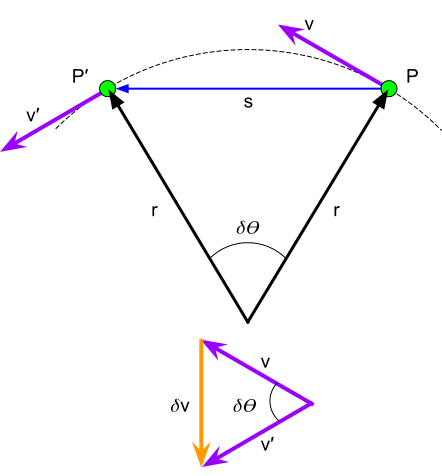
In the diagram the length of the arc (s) subtended by the angle δθ can be described by the time taken for an object with the velocity va to move through that angle, vδt.
The angle (δθ) can be described, using the definition of radians as:
Using the vector diagram above δθ can be shown to be $\delta\theta=\frac{\delta v}{v}$.
These two equations can be brought together,
Within these two terms we have a change in velocity (δv) and a change in time (δt), a change in velocity over time is acceleration, so the above equation can rearranged to show us the acceleration of an object with uniform circular motion or the centripetal acceleration.
We can now use this equation to show the force acting inwards on the object using Newton's second law, F=ma.
This is the centripetal force acting towards the centre of the circle, and is the resultant force keeping the object in its circular path.
It can be easily demonstrated that without this force the object would move tangentially to the circle. Centripetal force is not a true force, but is an adjectival force supplied by other forces such as gravity in the case of satellites, electrostatic forces between atoms in the case of tethered objects being spun, frictional forces etc.
Common exam mistake
Centripetal force is not a separate force to add to a free-body diagram — it's the name given to whichever resultant force (or combination of forces, such as tension, gravity, friction, or normal contact force) happens to be pointing towards the centre and keeping the object on its circular path. Drawing an extra "centripetal force" arrow alongside the real forces on a diagram is a common way to lose marks; instead, identify which existing force (or forces) is providing it.
Test yourself
Try the questions below to check your understanding of this topic. Numerical questions use different numbers each time, so you can attempt them more than once.